分库分表最佳实践:从基础原理到高阶架构设计
“分库分表的本质是为了解决单机数据库的物理极限。当单表数据超过 500万行 或 连接数/IO 打满时 ,传统的 B+ 树索引性能会急剧下降。这时候,必须通过拆分来用空间换时间。
“拆分策略通常分两步走:
- 先垂直拆分:按业务模块(如用户库、订单库)把数据物理隔离,解决业务耦合和连接数问题 。
- 再水平拆分:当单表数据量依然过大时,把一张大表拆成多个子表(分片)。基础策略有范围分片(扩容容易但有热点)和哈希分片(数据均匀但扩容难) 。”
“传统分片有两大痛点:扩容难和多维查询难。我们的最佳实践是用两套高阶方案来解决 :
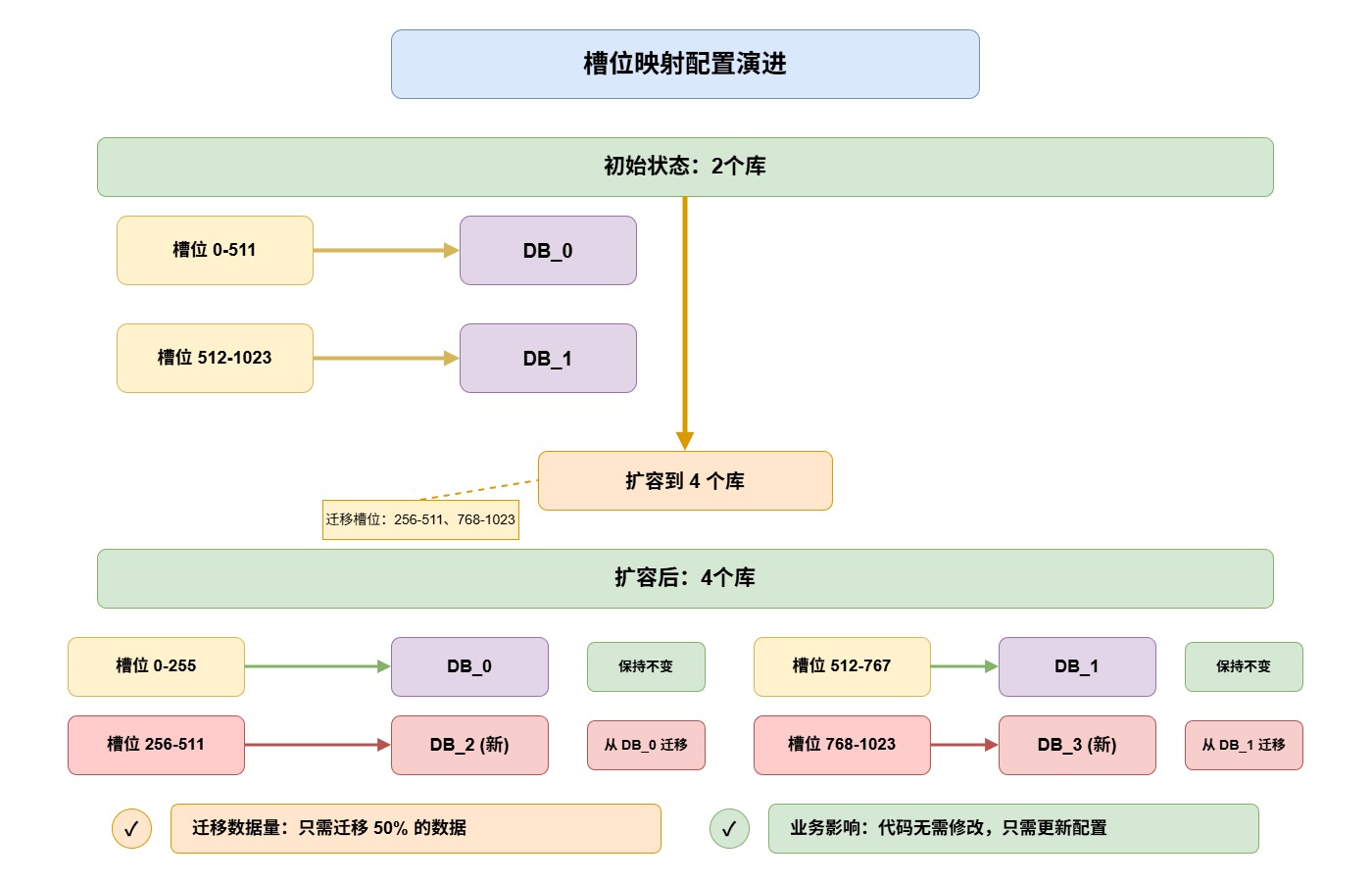
- 解决扩容难用‘虚拟槽’:引入一个逻辑层,数据映射到槽,槽再映射到库。扩容时只需要移动槽位,迁移数据量小且无需修改代码 。
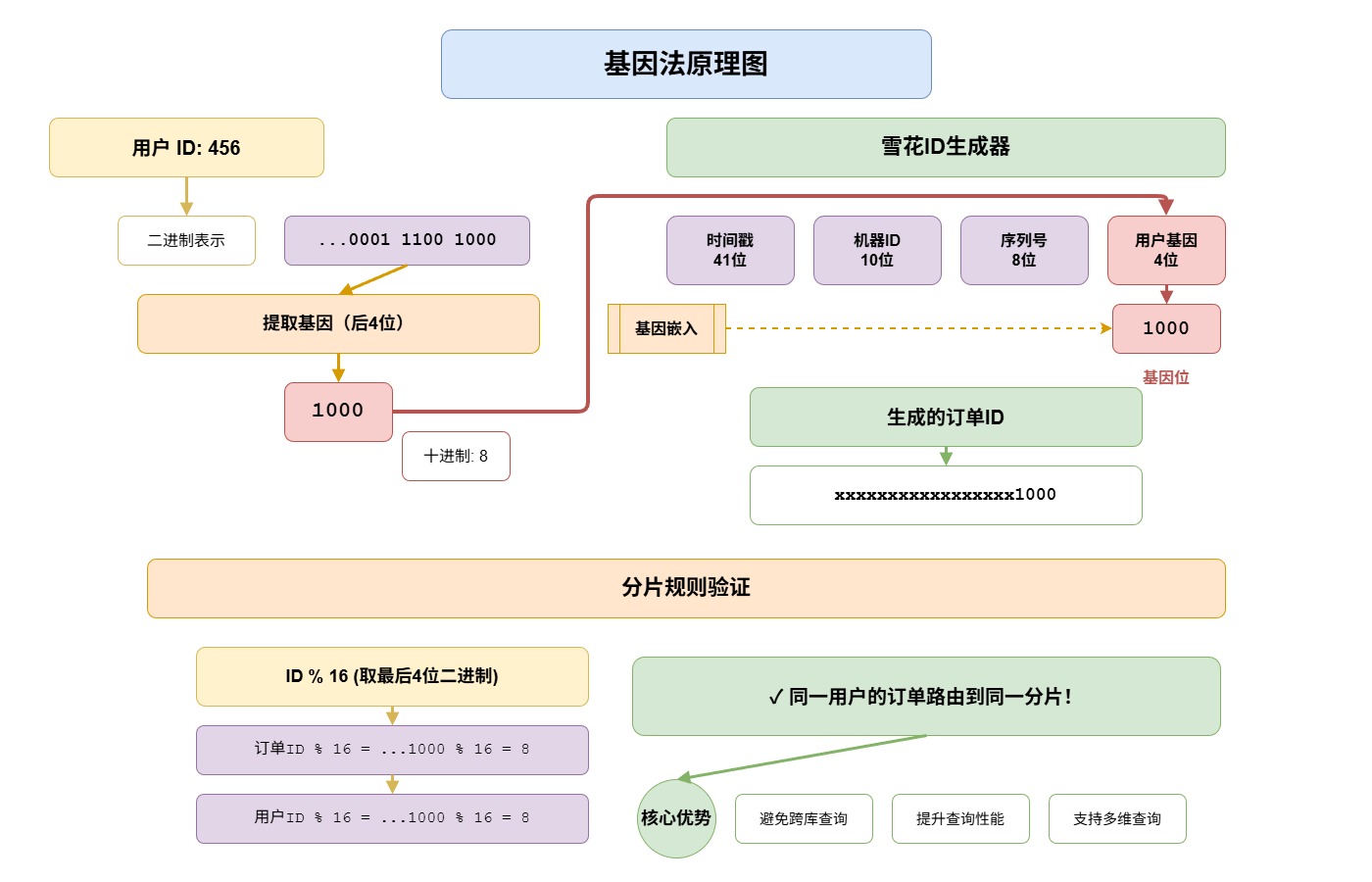
- 解决查询难用‘基因法’:在生成订单 ID(如雪花算法)时,把用户 ID 的最后几位(基因)嵌入进去。这样订单 ID 和用户 ID 的路由规则就一致了,彻底避免了跨库查询的全表扫描 。”
引言:为什么需要分库分表?
单库单表的性能瓶颈
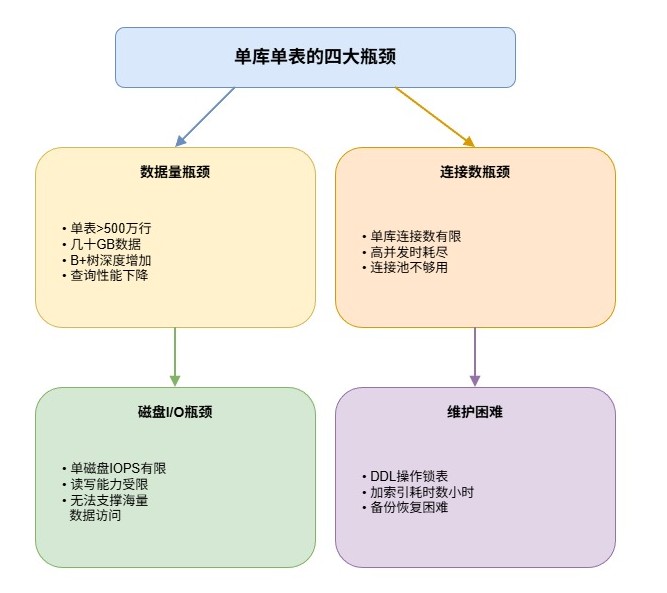
在单体应用或业务初期,我们通常使用单一数据库和单表存储数据。然而,随着业务增长,数据量激增,单表性能瓶颈逐渐显现:
- 数据量瓶颈:MySQL单表数据量超过 500 万行或几十 GB时,B+树索引深度增加,查询性能显著下降。
- 连接数瓶颈:单数据库连接数有限,高并发场景下连接池耗尽。
- 磁盘I/O瓶颈:单磁盘读写能力有限,无法支撑海量数据访问。
- 维护困难:单表过大时,DDL操作(如加索引)可能锁表数小时。
性能衰减量化分析
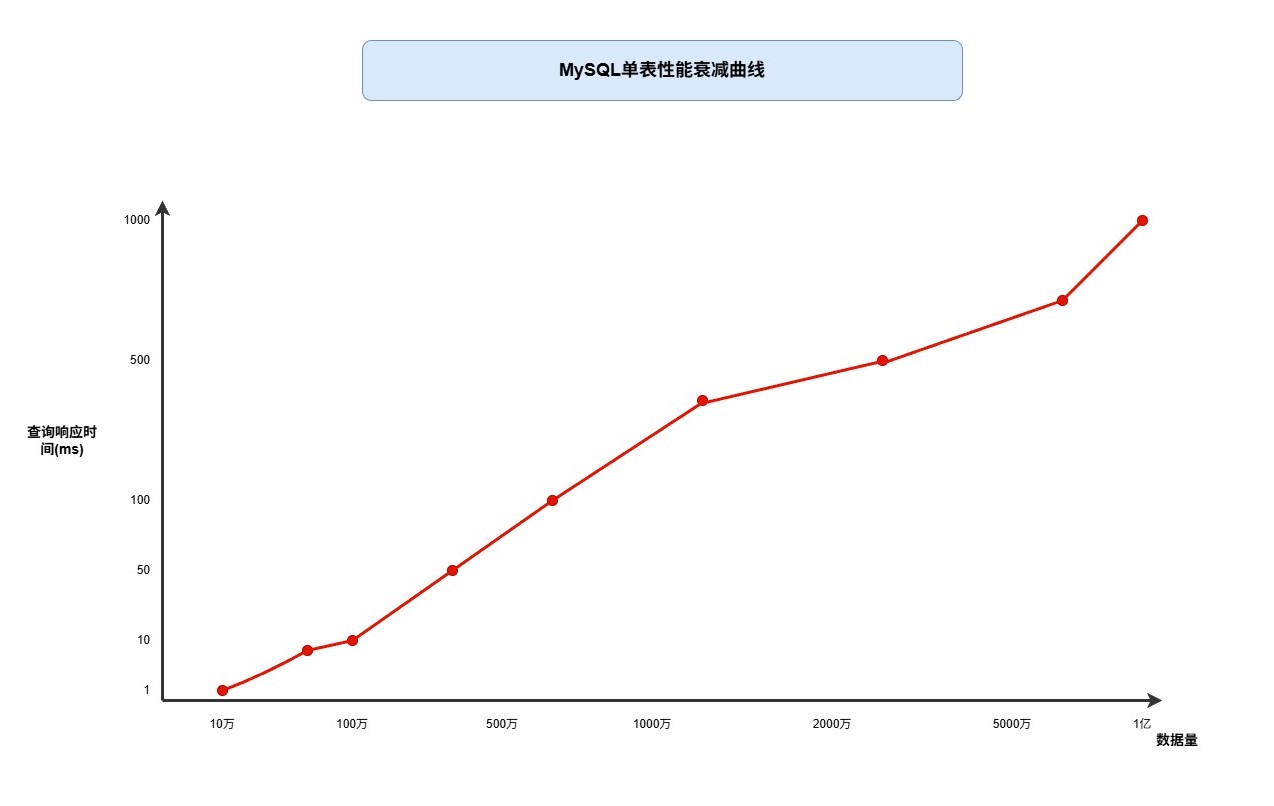
关键指标参考值:
| 数据量 | 索引深度 | 单次查询耗时 | 写入TPS |
|---|---|---|---|
| 100万 | 3层 | 1-5ms | 5000+ |
| 500万 | 3-4层 | 5-20ms | 3000 |
| 2000万 | 4层 | 20-100ms | 1000 |
| 1亿 | 4-5层 | 100-500ms | 300 |
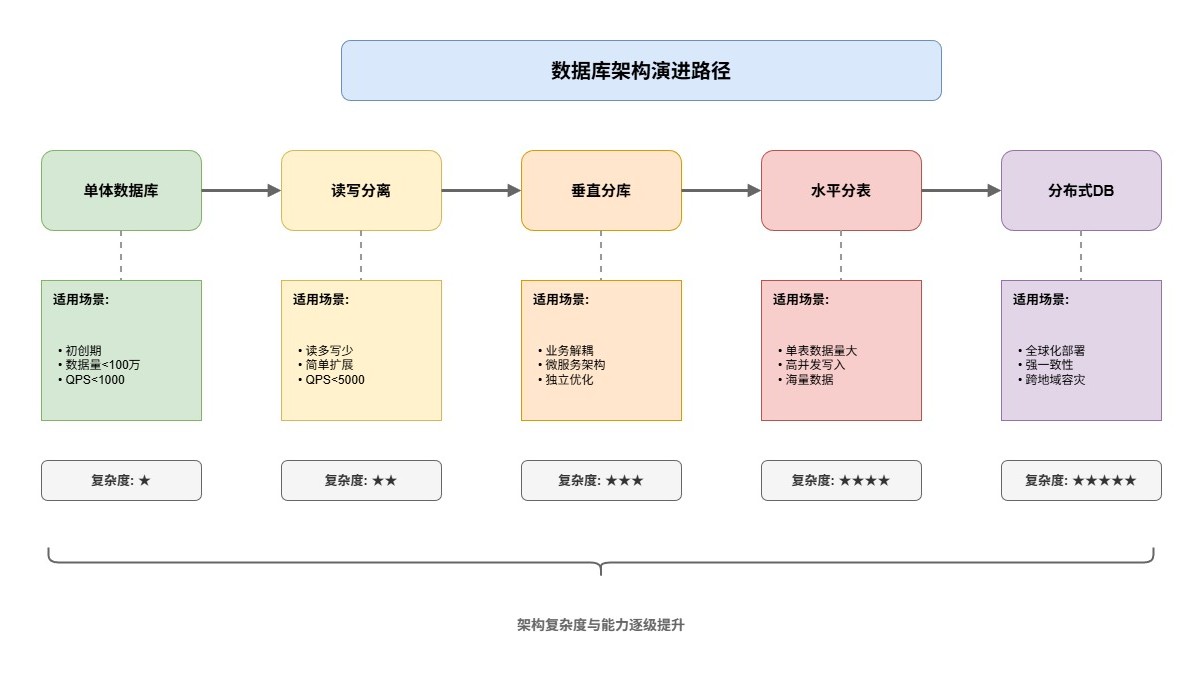
数据库架构演进路径
分库分表的基本策略
垂直拆分(Vertical Sharding)
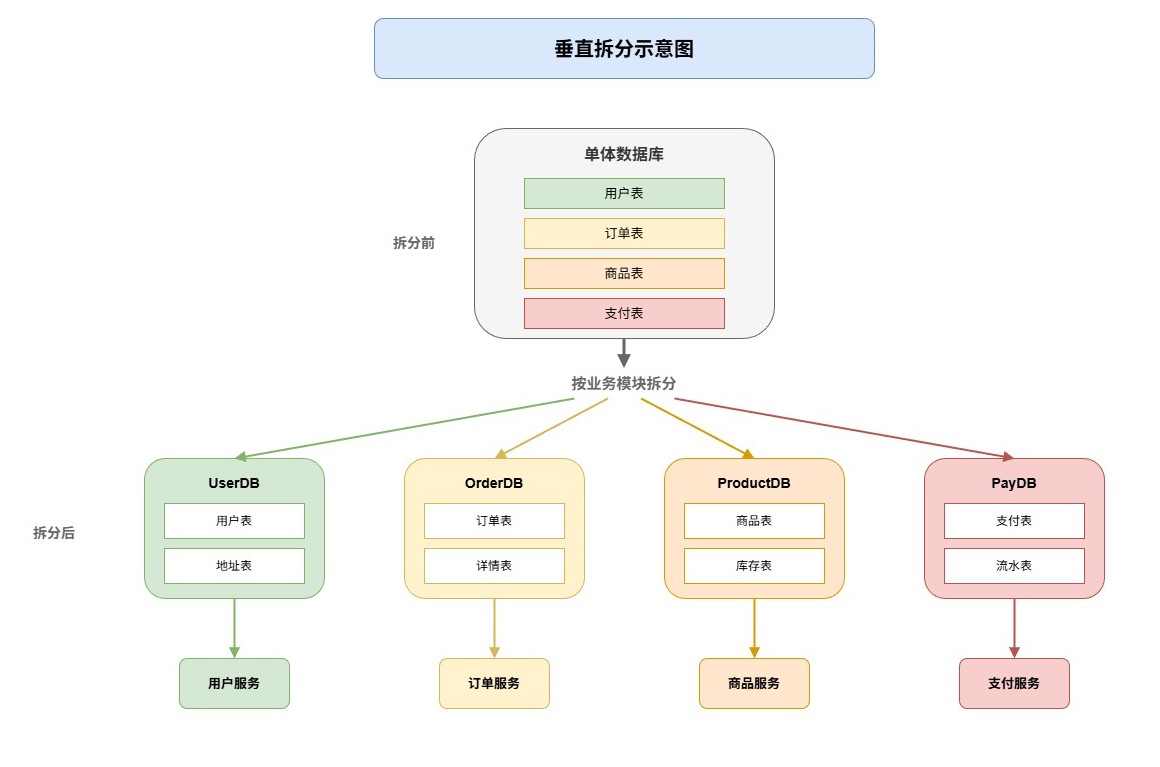
垂直分库
定义:按业务模块拆分数据库,每个服务独立使用一个数据库。
SQL示例
-- 拆分前:所有表在一个库
CREATE DATABASE app_db;
USE app_db;
CREATE TABLE user (...);
CREATE TABLE orders (...);
CREATE TABLE product (...);
CREATE TABLE payment (...);

-- 拆分后:每个业务独立数据库
CREATE DATABASE user_db;
USE user_db;
CREATE TABLE user (...);
CREATE TABLE user_address (...);

CREATE DATABASE order_db;
USE order_db;
CREATE TABLE orders (...);
CREATE TABLE order_item (...);

CREATE DATABASE product_db;
USE product_db;
CREATE TABLE product (...);
CREATE TABLE inventory (...);
优缺点对比
| 优点 | 缺点 |
|---|---|
| 业务解耦,不同业务使用不同数据库 | 无法解决单表数据量大的问题 |
| 单表数据量相对可控 | 跨库事务复杂(需要分布式事务) |
| 减少单库连接数压力 | 跨库JOIN需要在应用层处理 |
| 便于按业务特点独立优化 | 数据库运维成本增加 |
| 故障隔离,一个库挂不影响其他 | 需要处理数据一致性问题 |
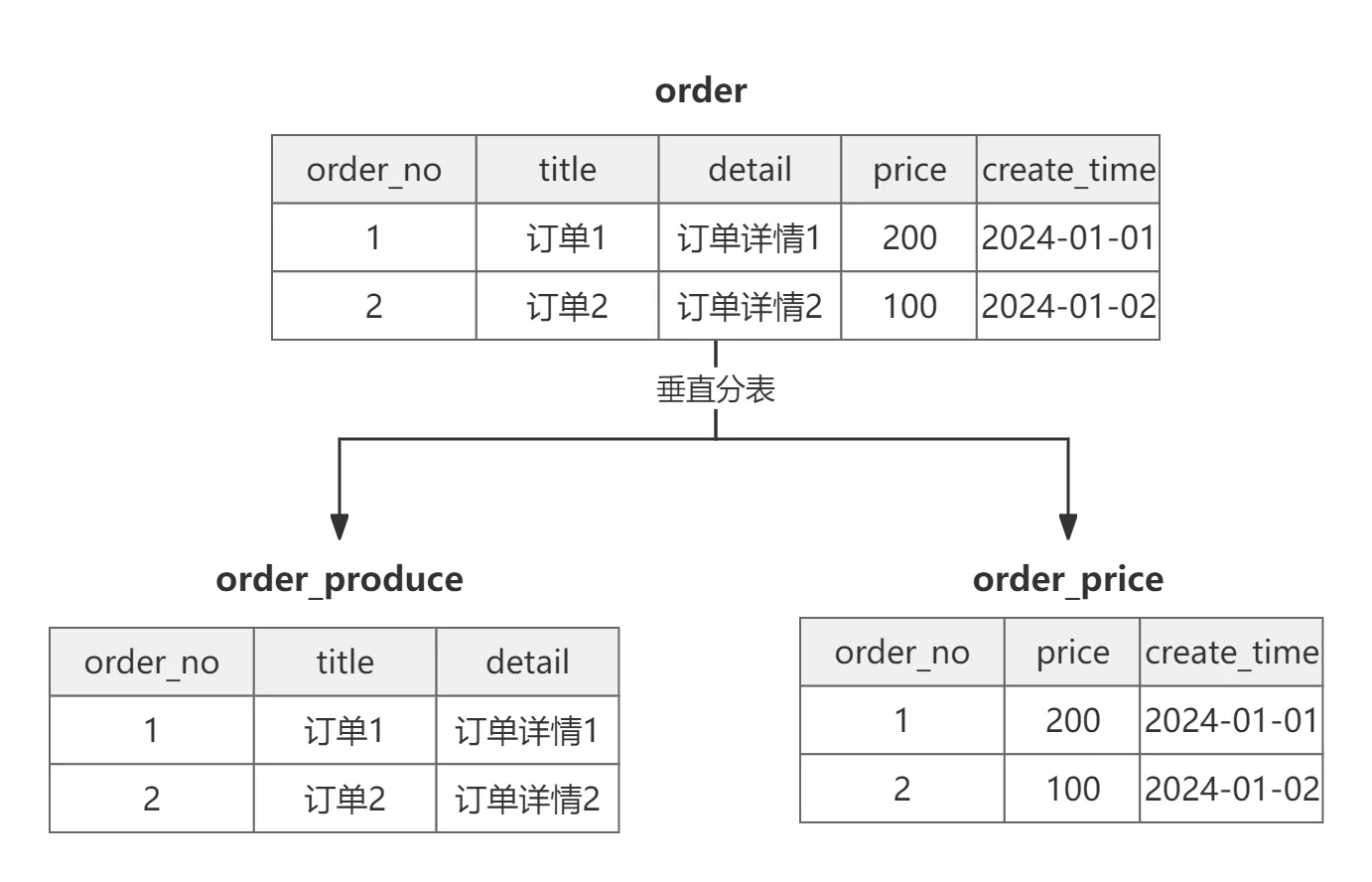
垂直分表
垂直分表适用于字段非常多的表,对于很多的查询来说,其实不需要一次将所有的字段全都查询出来,这样很浪费性能,影响效率,那么就将经常查询的字段单独拆分出一个表,将另外的字段单独拆分成另一个表,拆分后的表通过某个字段关联起来,这样既可以减少表的容量大小,又可以提升查询效率
水平拆分(Horizontal Sharding)
垂直拆分其实还是根据业务进行模块话拆分的,当单表的容量越来越大的时候,还是不能解决单表的读写、存储的性能瓶颈,这是就需要水平拆分了
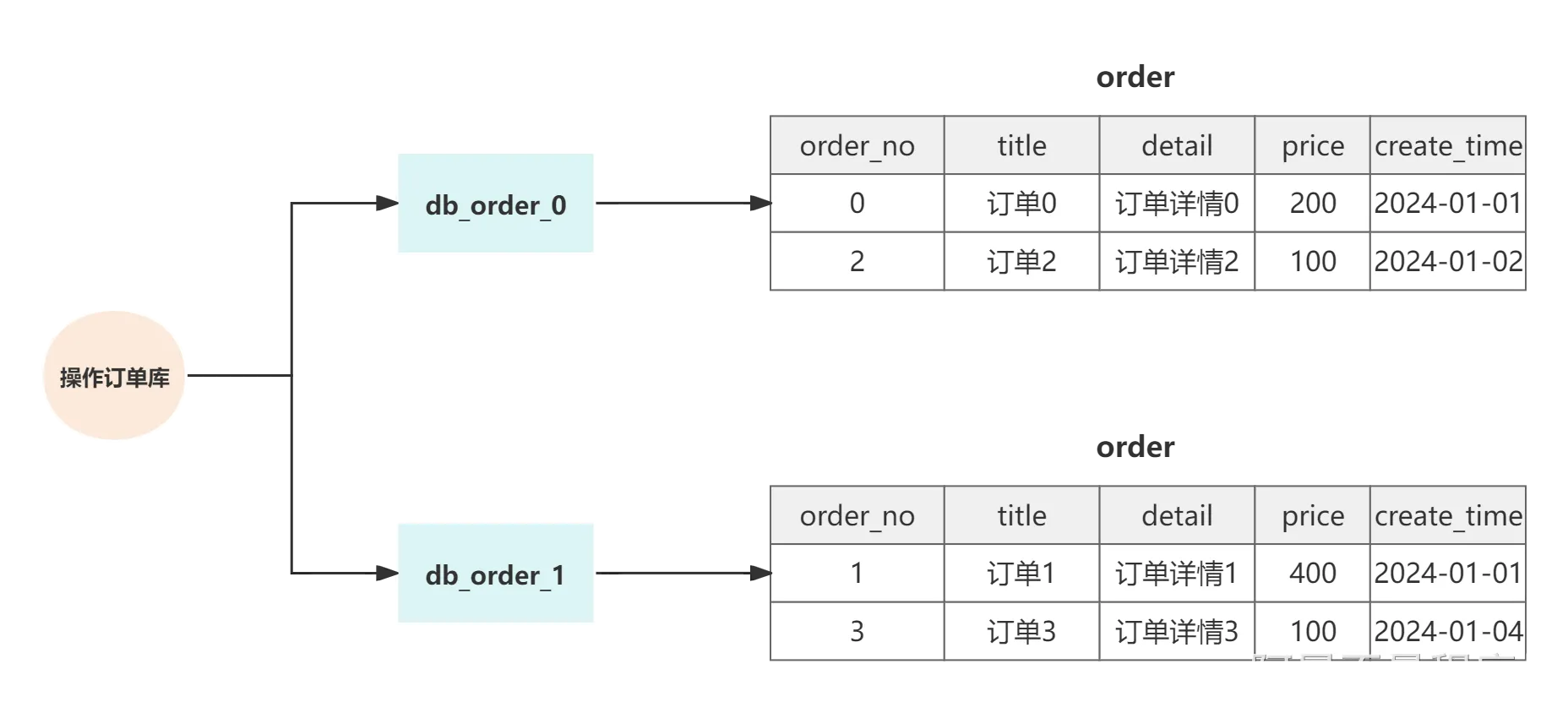
水平分库
水平分库是把同一个表按一定规则拆分到不同的数据库中,每个库可以位于不同的服务器上,每个数据库的库和表结构都是相同的,只有表中的数据不同。可以实现水平扩展,有效缓解单库的性能瓶颈
定义:将单表数据按某种规则拆分到多个表或库中,每个分片包含部分数据。
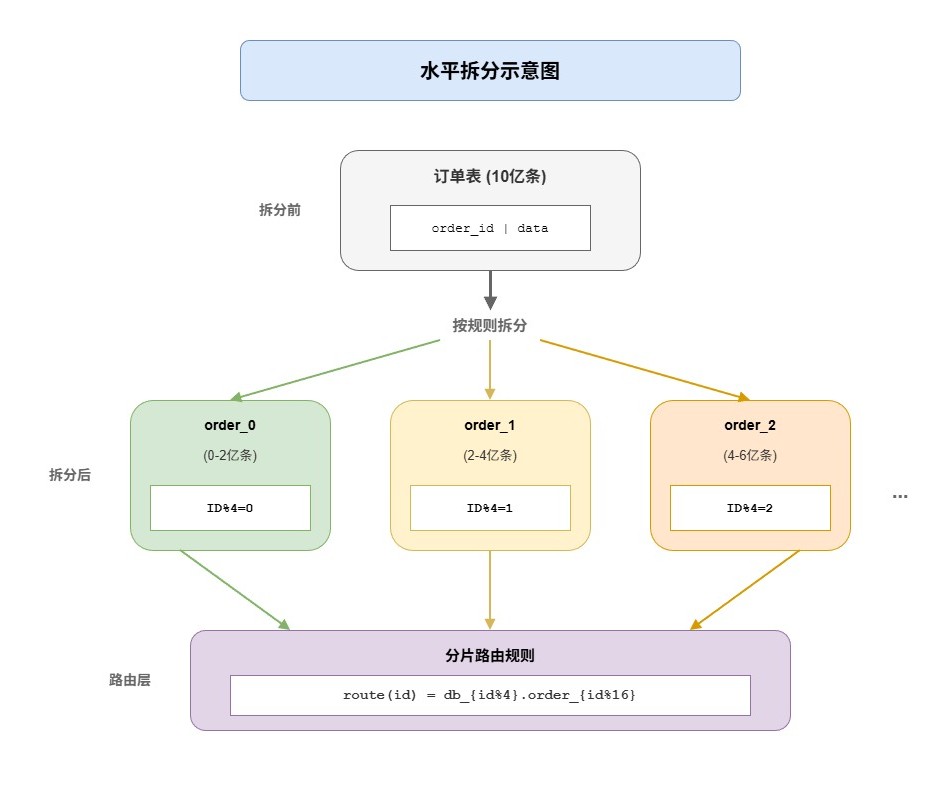
水平分片策略详解
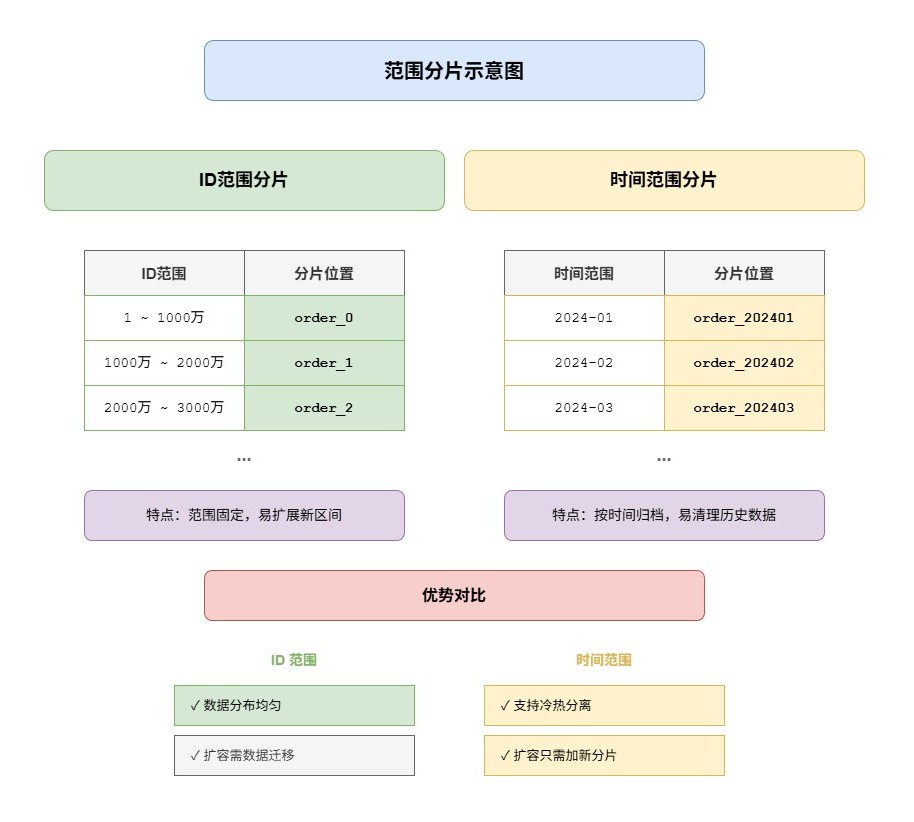
策略一:范围分片(Range Sharding)
做法:按 ID 或时间范围划分数据。
代码实现:
/**
 * 范围分片算法
 */
public class RangeShardingAlgorithm {

    private static final long RANGE_SIZE = 10_000_000L; // 每个分片1000万条

    /**
     * 按ID范围路由
     */
    public String routeById(Long id) {
        int shardIndex = (int) (id / RANGE_SIZE);
        return String.format("order_%d", shardIndex);
    }

    /**
     * 按时间范围路由
     */
    public String routeByTime(LocalDateTime createTime) {
        String suffix = createTime.format(DateTimeFormatter.ofPattern("yyyyMM"));
        return String.format("order_%s", suffix);
    }

    /**
     * 范围查询路由 - 返回需要查询的所有分片
     */
    public List<String> routeByRange(Long startId, Long endId) {
        List<String> shards = new ArrayList<>();
        int startShard = (int) (startId / RANGE_SIZE);
        int endShard = (int) (endId / RANGE_SIZE);

        for (int i = startShard; i <= endShard; i++) {
            shards.add(String.format("order_%d", i));
        }
        return shards;
    }
}
优缺点:
| 优点 | 缺点 |
|---|---|
| 扩容简单,直接增加新分片 | 热点问题:最新数据集中在最后一个分片 |
| 范围查询高效(如查最近订单) | 数据倾斜:不同范围数据量可能差异大 |
| 数据归档方便(可直接删除旧分片) | 迁移困难:范围调整需大量数据迁移 |
| 实现简单,逻辑清晰 | 写入压力不均衡 |
策略二:哈希分片(Hash Sharding)
做法:通过哈希函数(如 ID % N)将数据均匀分布到 N 个库/表。
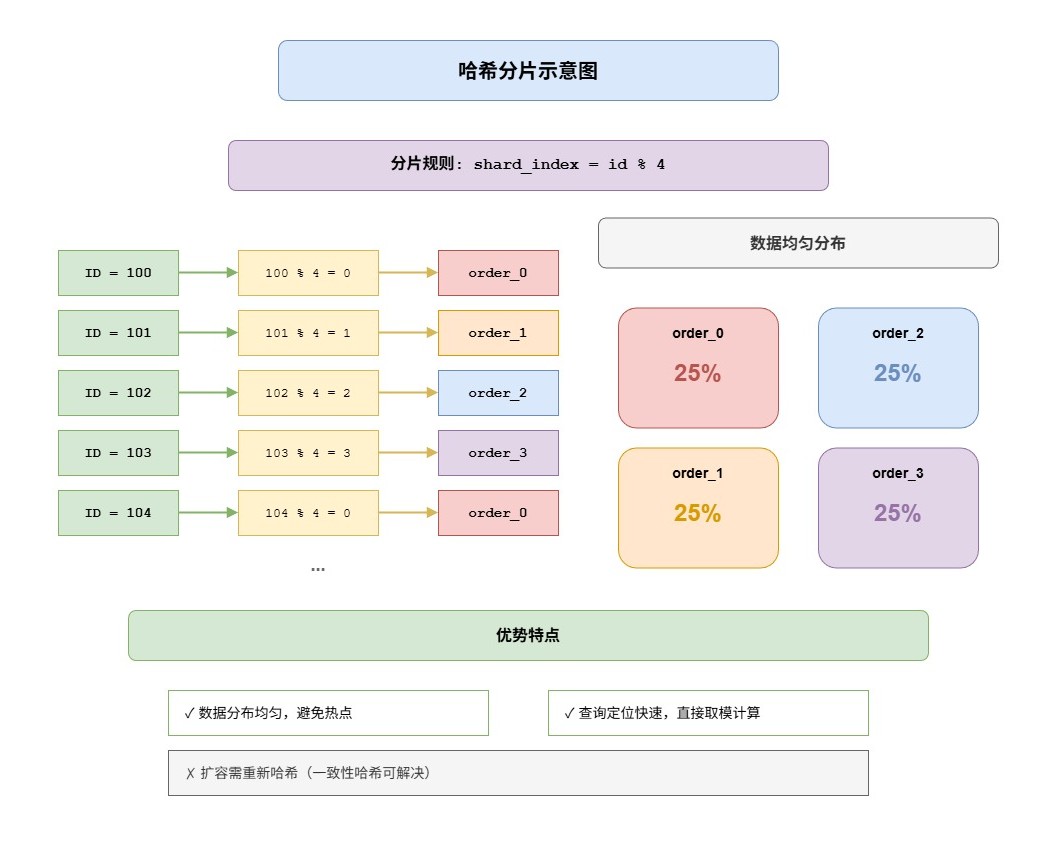
代码实现:
/**
 * 哈希分片算法
 */
public class HashShardingAlgorithm {

    private final int dbCount;      // 数据库数量
    private final int tableCount;   // 每个库的表数量

    public HashShardingAlgorithm(int dbCount, int tableCount) {
        this.dbCount = dbCount;
        this.tableCount = tableCount;
    }

    /**
     * 传统取模分片
     * @param id 分片键
     * @return 格式: db_X.order_Y
     */
    public String route(Long id) {
        // 计算数据库索引
        int dbIndex = (int) (id % dbCount);
        // 计算表索引(使用二次哈希避免数据集中)
        int tableIndex = (int) ((id / dbCount) % tableCount);

        return String.format("db_%d.order_%d", dbIndex, tableIndex);
    }

    /**
     * 一致性哈希分片(更优的实现)
     */
    public String routeWithConsistentHash(Long id) {
        // 计算哈希值(使用MurmurHash等高质量哈希函数)
        int hash = MurmurHash.hash(id.toString());

        // 映射到分片
        int totalShards = dbCount * tableCount;
        int shardIndex = Math.abs(hash % totalShards);

        int dbIndex = shardIndex / tableCount;
        int tableIndex = shardIndex % tableCount;

        return String.format("db_%d.order_%d", dbIndex, tableIndex);
    }
}
扩容灾难问题:
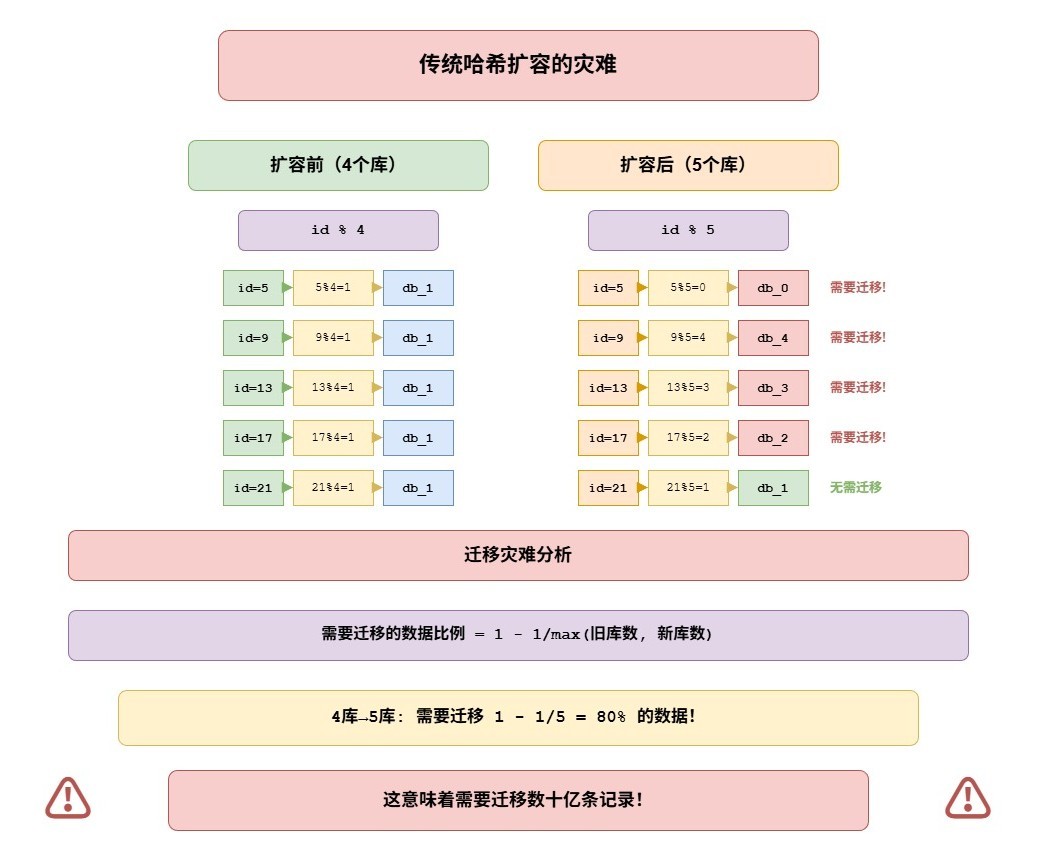
优缺点:
| 优点 | 缺点 |
|---|---|
| 数据分布均匀,负载均衡 | 扩容灾难:分片数变化导致大量数据迁移 |
| 写入压力均衡 | 范围查询需全分片扫描 |
| 适合高并发点查场景 | 多维查询困难:按其他字段查询无法定位分片 |
| 无热点问题 | 分片数必须提前规划好 |
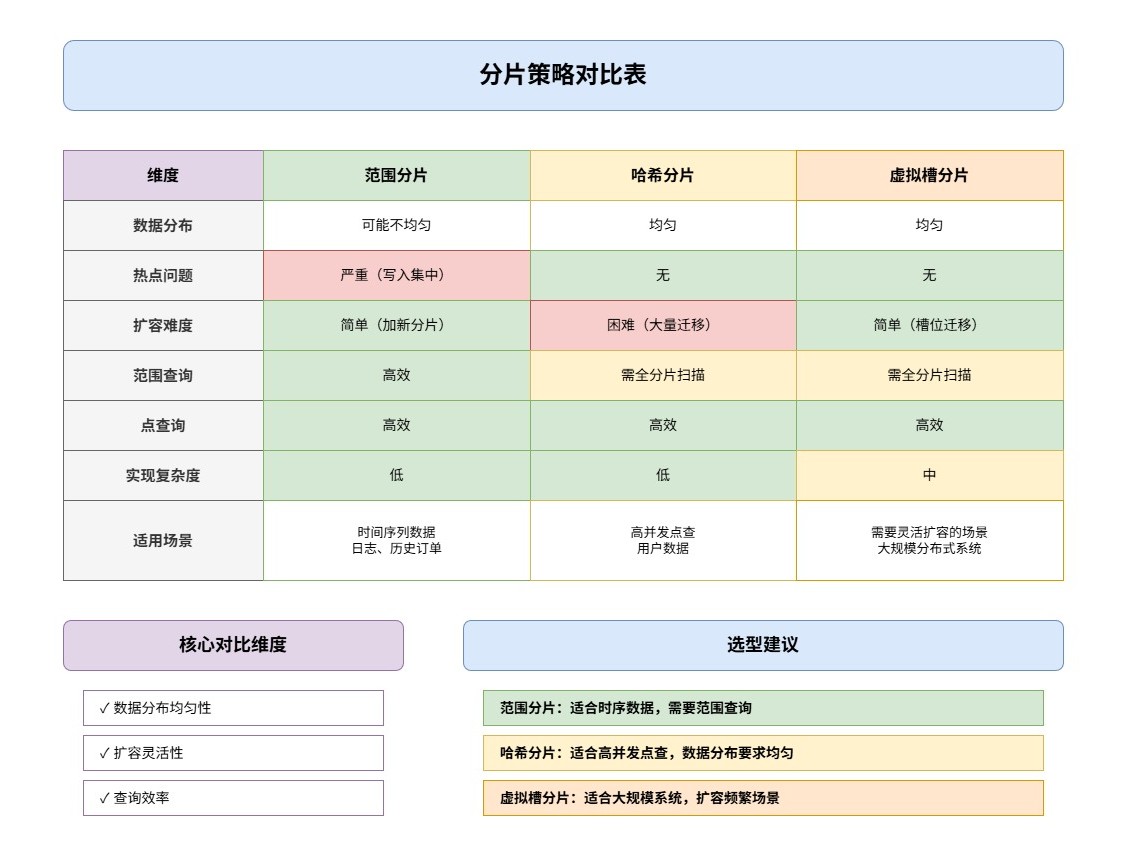
分片策略对比总结
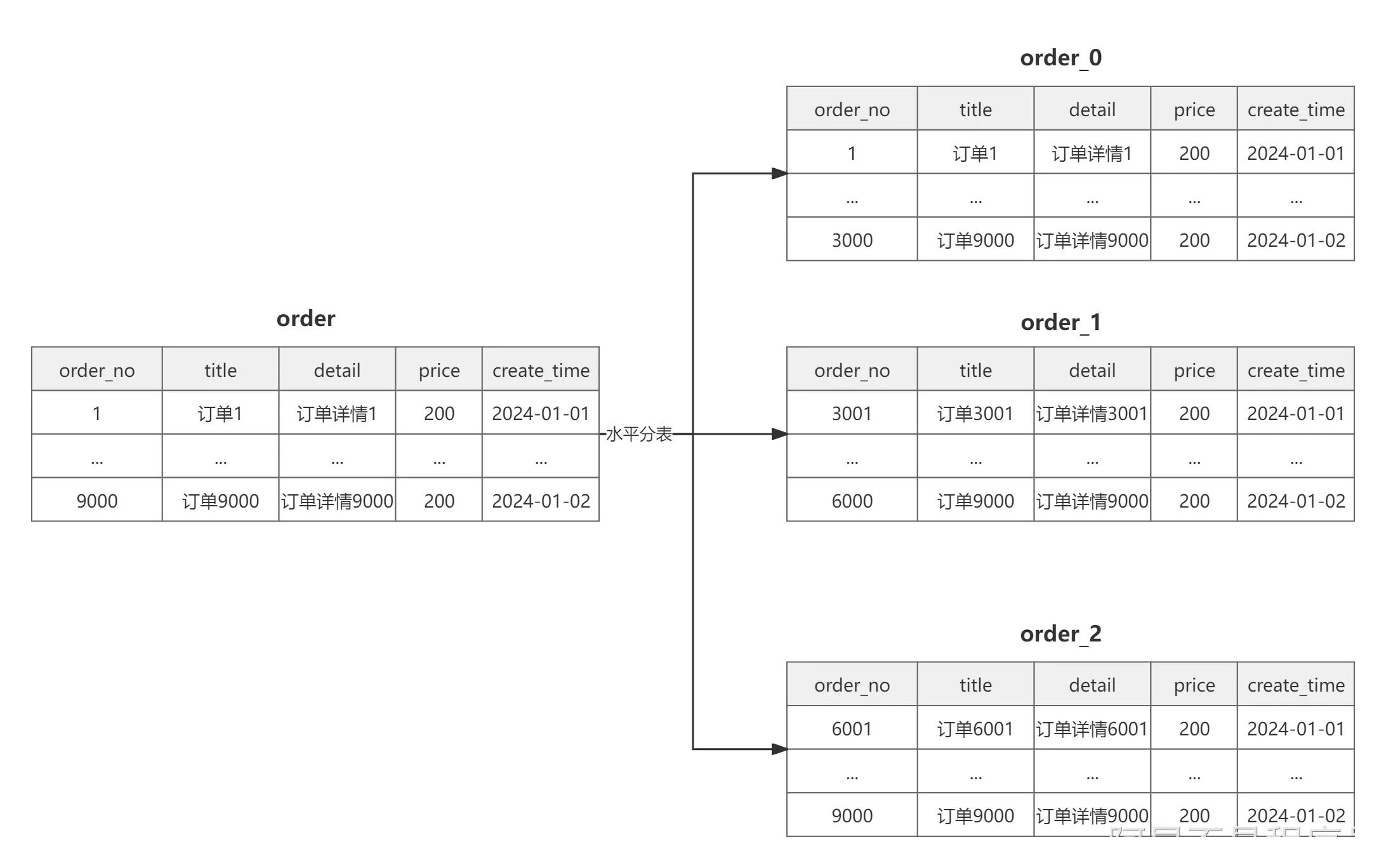
水平分表
水平分表是在同一个数据库内,对大表进行水平拆分,分割成多个表结构相同的表
高阶架构:解决传统分片的痛点
痛点与解决方案概览
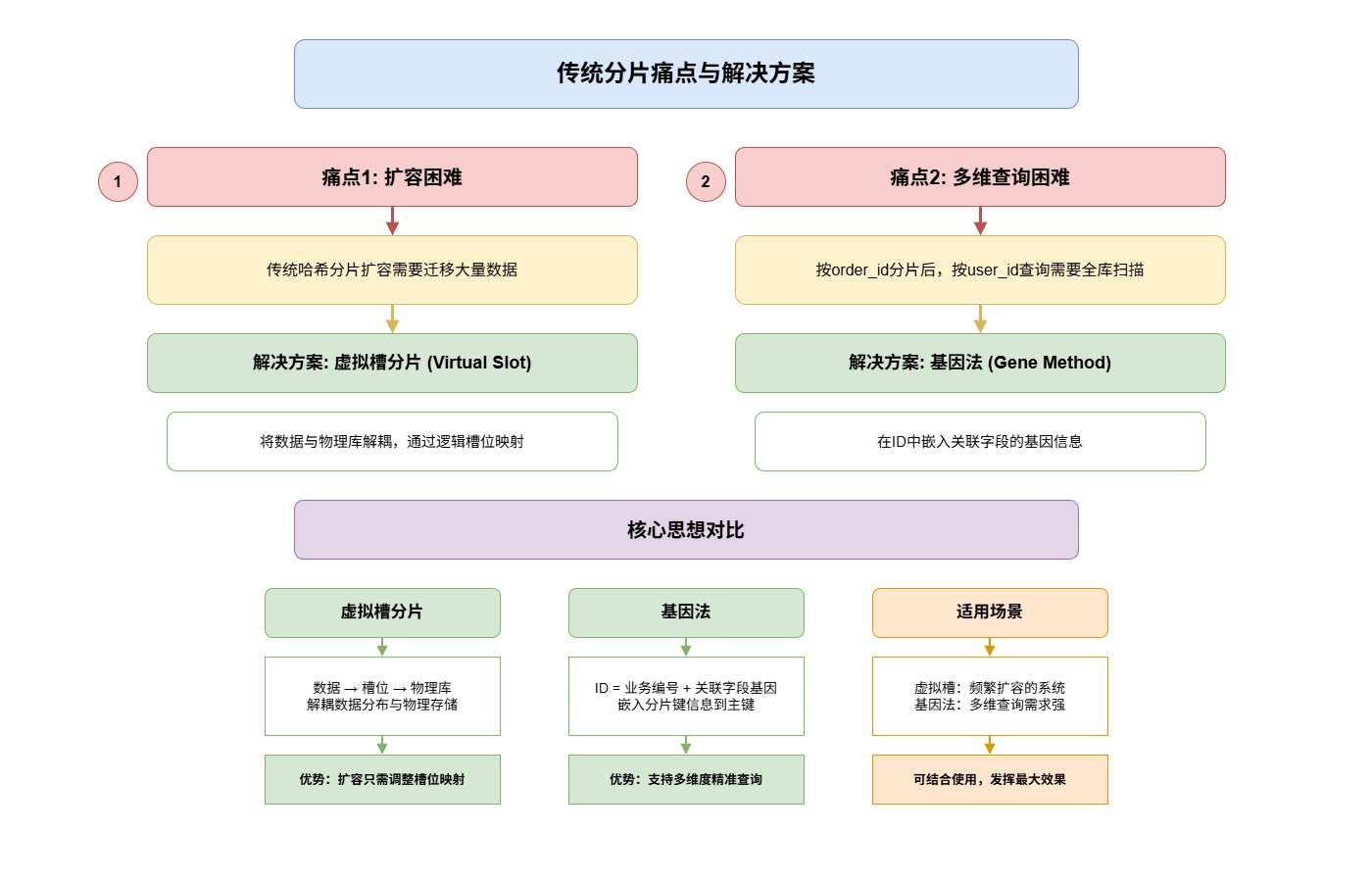
虚拟槽分片(Virtual Slot Sharding):解决扩容难题
核心思想:两层映射
将数据与物理库解耦,通过逻辑槽位映射到物理库。
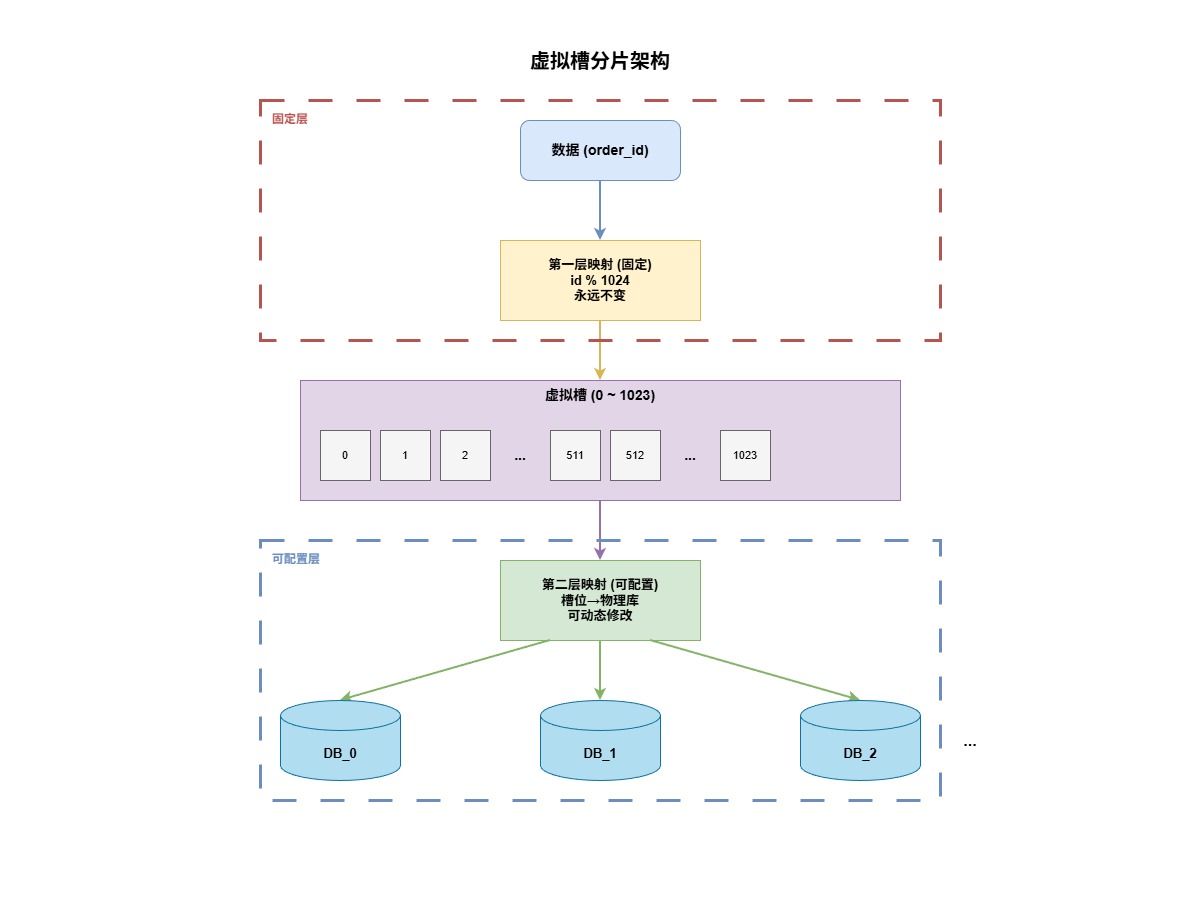
槽位映射示例
代码实现
/**
 * 虚拟槽分片算法
 */
public class VirtualSlotAlgorithm implements StandardShardingAlgorithm<Long> {

    private static final int VIRTUAL_SLOT_COUNT = 1024;  // 虚拟槽数量(固定)

    // 槽位到物理库的映射(从配置中心动态加载)
    private volatile Map<Integer, String> slotToDbMapping;

    /**
     * 第一层映射:数据到虚拟槽(永远不变)
     */
    private int calculateVirtualSlot(Long shardingValue) {
        return (int) (shardingValue % VIRTUAL_SLOT_COUNT);
    }

    /**
     * 第二层映射:虚拟槽到物理库(可动态配置)
     */
    private String routeToPhysicalDB(int virtualSlot) {
        return slotToDbMapping.get(virtualSlot);
    }

    @Override
    public String doSharding(Collection<String> availableTargetNames,
                            PreciseShardingValue<Long> shardingValue) {
        // 1. 计算虚拟槽位
        int slot = calculateVirtualSlot(shardingValue.getValue());

        // 2. 根据配置映射到物理库
        String targetDb = routeToPhysicalDB(slot);

        log.debug("Routing: value={}, slot={}, db={}",
                  shardingValue.getValue(), slot, targetDb);

        return targetDb;
    }

    /**
     * 动态更新映射配置(配置中心回调)
     */
    @NacosConfigListener(dataId = "sharding-config")
    public void onConfigUpdate(String newConfig) {
        this.slotToDbMapping = parseSlotMapping(newConfig);
        log.info("Slot mapping updated: {}", slotToDbMapping);
    }

    /**
     * 解析槽位映射配置
     */
    private Map<Integer, String> parseSlotMapping(String config) {
        Map<Integer, String> mapping = new HashMap<>();

        // 配置格式: {"0-255": "db_0", "256-511": "db_2", ...}
        JsonNode root = objectMapper.readTree(config);
        root.fields().forEachRemaining(entry -> {
            String range = entry.getKey();
            String db = entry.getValue().asText();

            String[] parts = range.split("-");
            int start = Integer.parseInt(parts[0]);
            int end = Integer.parseInt(parts[1]);

            for (int i = start; i <= end; i++) {
                mapping.put(i, db);
            }
        });

        return mapping;
    }
}
ShardingSphere配置示例
# application-sharding.yml
spring:
  shardingsphere:
    datasource:
      names: db_0, db_1, db_2, db_3
      db_0:
        type: com.zaxxer.hikari.HikariDataSource
        driver-class-name: com.mysql.cj.jdbc.Driver
        jdbc-url: jdbc:mysql://192.168.1.10:3306/order_db_0
        username: root
        password: ${DB_PASSWORD}
      db_1:
        type: com.zaxxer.hikari.HikariDataSource
        driver-class-name: com.mysql.cj.jdbc.Driver
        jdbc-url: jdbc:mysql://192.168.1.11:3306/order_db_1
        username: root
        password: ${DB_PASSWORD}
      # ... db_2, db_3 配置类似

    rules:
      sharding:
        tables:
          d_order:
            actual-data-nodes: db_${0..3}.d_order_${0..15}
            database-strategy:
              standard:
                sharding-column: order_id
                sharding-algorithm-name: virtual-slot-db
            table-strategy:
              standard:
                sharding-column: order_id
                sharding-algorithm-name: virtual-slot-table

        sharding-algorithms:
          # 虚拟槽算法 - 库路由
          virtual-slot-db:
            type: CLASS_BASED
            props:
              strategy: STANDARD
              algorithmClassName: com.damai.sharding.VirtualSlotAlgorithm

          # 虚拟槽算法 - 表路由
          virtual-slot-table:
            type: HASH_MOD
            props:
              sharding-count: 16  # 每个库16张表
扩容流程详解
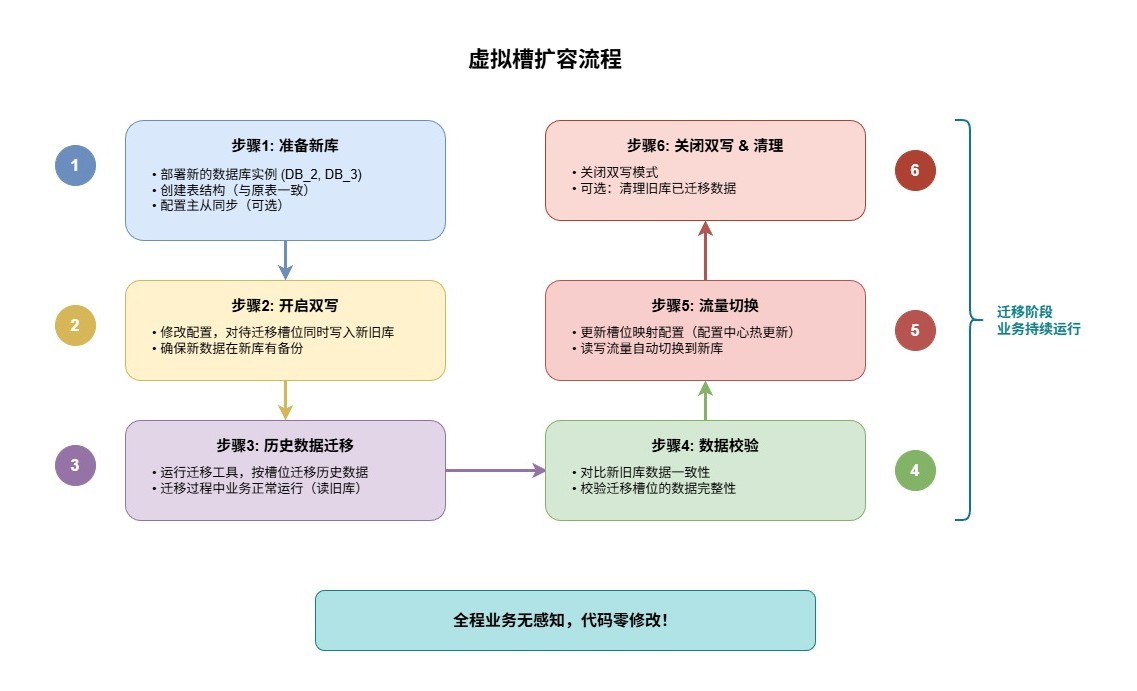
优势
- 无需修改代码:分片算法永远是
ID % 1024,业务逻辑不变。 - 迁移数据量可控:只需迁移部分槽位的数据,而非全量数据。
- 平滑扩容:支持在线扩容,无需停机。
基因法(Gene Method):解决多维查询难题
问题场景
-- 按订单ID查询(高效 ✓ 知道分片位置)
SELECT * FROM orders WHERE order_id = 1234567890;

-- 按用户ID查询(低效 ✗ 需要全库扫描)
SELECT * FROM orders WHERE user_id = 456;
-- 不知道用户的订单在哪个分片!需要查询所有分片!
核心思想:
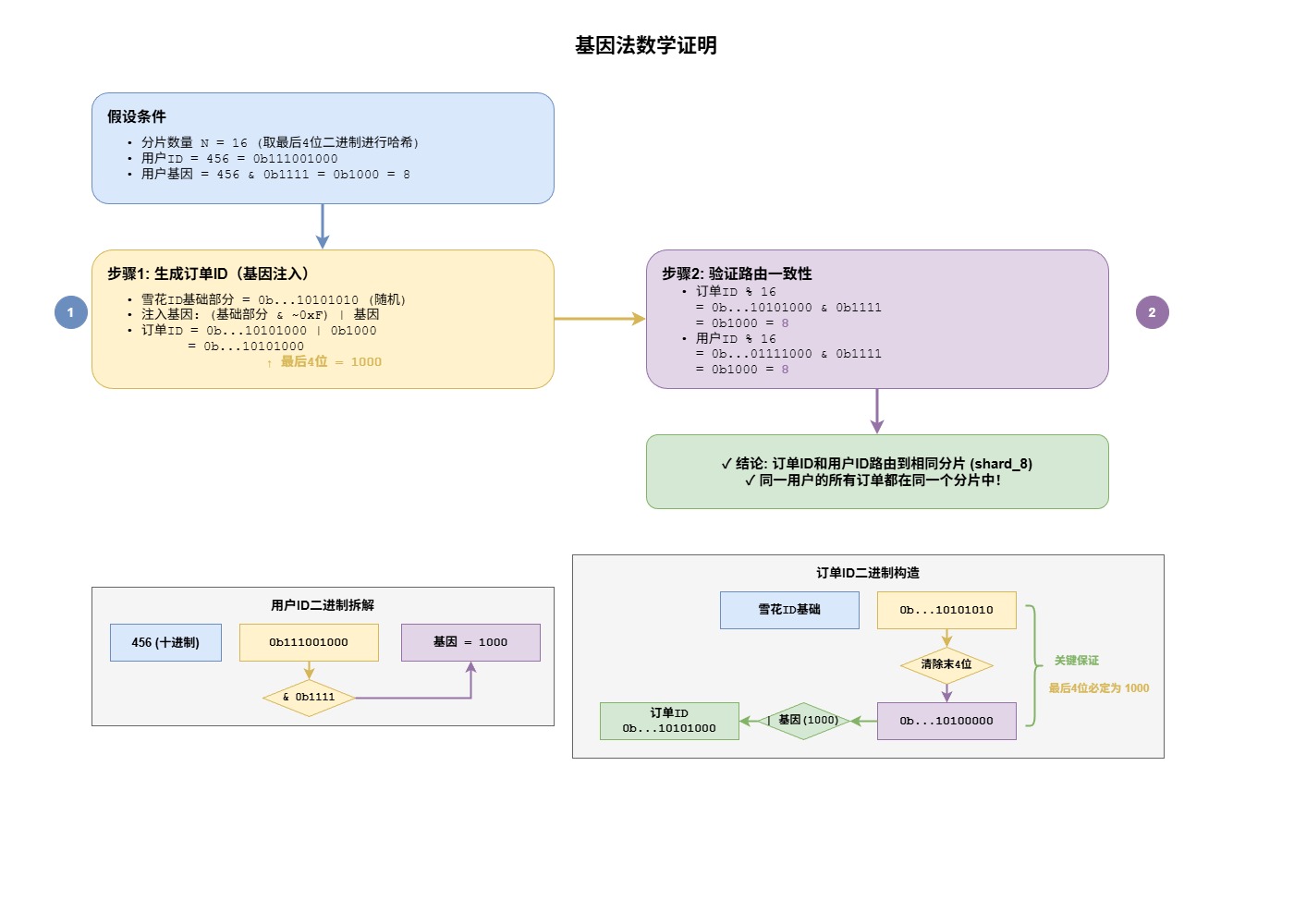
在分布式ID中嵌入用户基因,使得 order_id 和 user_id 在分片规则上保持一致。
数学证明:
代码实现:
/**
 * 带基因的分布式ID生成器
 */
@Component
public class GeneIdGenerator {

    // 基因位数(决定最大分片数:2^GENE_BITS)
    private static final int GENE_BITS = 4;

    // 基因掩码:00001111
    private static final long GENE_MASK = (1L << GENE_BITS) - 1;

    @Autowired
    private Snowflake snowflake;  // 雪花算法生成器

    /**
     * 生成带用户基因的订单ID
     *
     * @param userId 用户ID
     * @return 带基因的订单ID
     */
    public long generateOrderId(long userId) {
        // 1. 生成基础雪花ID
        long baseId = snowflake.nextId();

        // 2. 提取用户基因(最后4位)
        long userGene = userId & GENE_MASK;

        // 3. 将基因注入订单ID
        // 清除雪花ID的最后4位,然后或上用户基因
        long orderId = (baseId & ~GENE_MASK) | userGene;

        return orderId;
    }

    /**
     * 从订单ID提取用户基因
     * 用于验证或调试
     */
    public long extractGene(long orderId) {
        return orderId & GENE_MASK;
    }

    /**
     * 验证订单ID和用户ID的基因是否匹配
     */
    public boolean validateGene(long orderId, long userId) {
        long orderGene = orderId & GENE_MASK;
        long userGene = userId & GENE_MASK;
        return orderGene == userGene;
    }

    /**
     * 生成带商家基因的商品ID(多基因场景)
     */
    public long generateProductId(long sellerId) {
        long baseId = snowflake.nextId();
        long sellerGene = sellerId & GENE_MASK;
        return (baseId & ~GENE_MASK) | sellerGene;
    }
}
基因法分片算法:
/**
 * 基因法分片算法
 */
public class GeneShardingAlgorithm implements StandardShardingAlgorithm<Long> {

    private static final int GENE_BITS = 4;
    private static final long GENE_MASK = (1L << GENE_BITS) - 1;

    private final int shardCount;  // 分片数量,必须是2的幂次

    public GeneShardingAlgorithm(int shardCount) {
        // 验证分片数是2的幂次
        if ((shardCount & (shardCount - 1)) != 0) {
            throw new IllegalArgumentException("Shard count must be power of 2");
        }
        // 验证分片数不超过基因容量
        if (shardCount > (1 << GENE_BITS)) {
            throw new IllegalArgumentException("Shard count exceeds gene capacity");
        }
        this.shardCount = shardCount;
    }

    @Override
    public String doSharding(Collection<String> availableTargetNames,
                            PreciseShardingValue<Long> shardingValue) {
        Long value = shardingValue.getValue();

        // 提取基因位进行分片
        int gene = (int) (value & GENE_MASK);
        int shardIndex = gene % shardCount;

        return String.format("order_%d", shardIndex);
    }

    @Override
    public Collection<String> doSharding(Collection<String> availableTargetNames,
                                        RangeShardingValue<Long> shardingValue) {
        // 范围查询需要扫描所有分片
        return availableTargetNames;
    }
}
多基因场景:
/**
 * 多基因ID生成器
 * 支持将多个维度的基因嵌入ID
 */
public class MultiGeneIdGenerator {

    // 双基因:用户基因(4位) + 商家基因(4位) = 8位
    private static final int USER_GENE_BITS = 4;
    private static final int SELLER_GENE_BITS = 4;
    private static final long USER_GENE_MASK = 0xF;    // 最后4位
    private static final long SELLER_GENE_MASK = 0xF0; // 倒数5-8位

    /**
     * 生成带双基因的订单ID
     * 支持按用户ID或商家ID查询时都能定位分片
     */
    public long generateOrderId(long userId, long sellerId) {
        long baseId = snowflake.nextId();

        // 提取基因
        long userGene = userId & 0xF;
        long sellerGene = (sellerId & 0xF) << 4;

        // 注入双基因
        long orderId = (baseId & ~0xFF) | sellerGene | userGene;

        return orderId;
    }

    /**
     * 按用户维度分片
     */
    public int shardByUser(long orderId) {
        return (int) (orderId & USER_GENE_MASK);
    }

    /**
     * 按商家维度分片
     */
    public int shardBySeller(long orderId) {
        return (int) ((orderId & SELLER_GENE_MASK) >> 4);
    }
}
完整的最佳实践架构
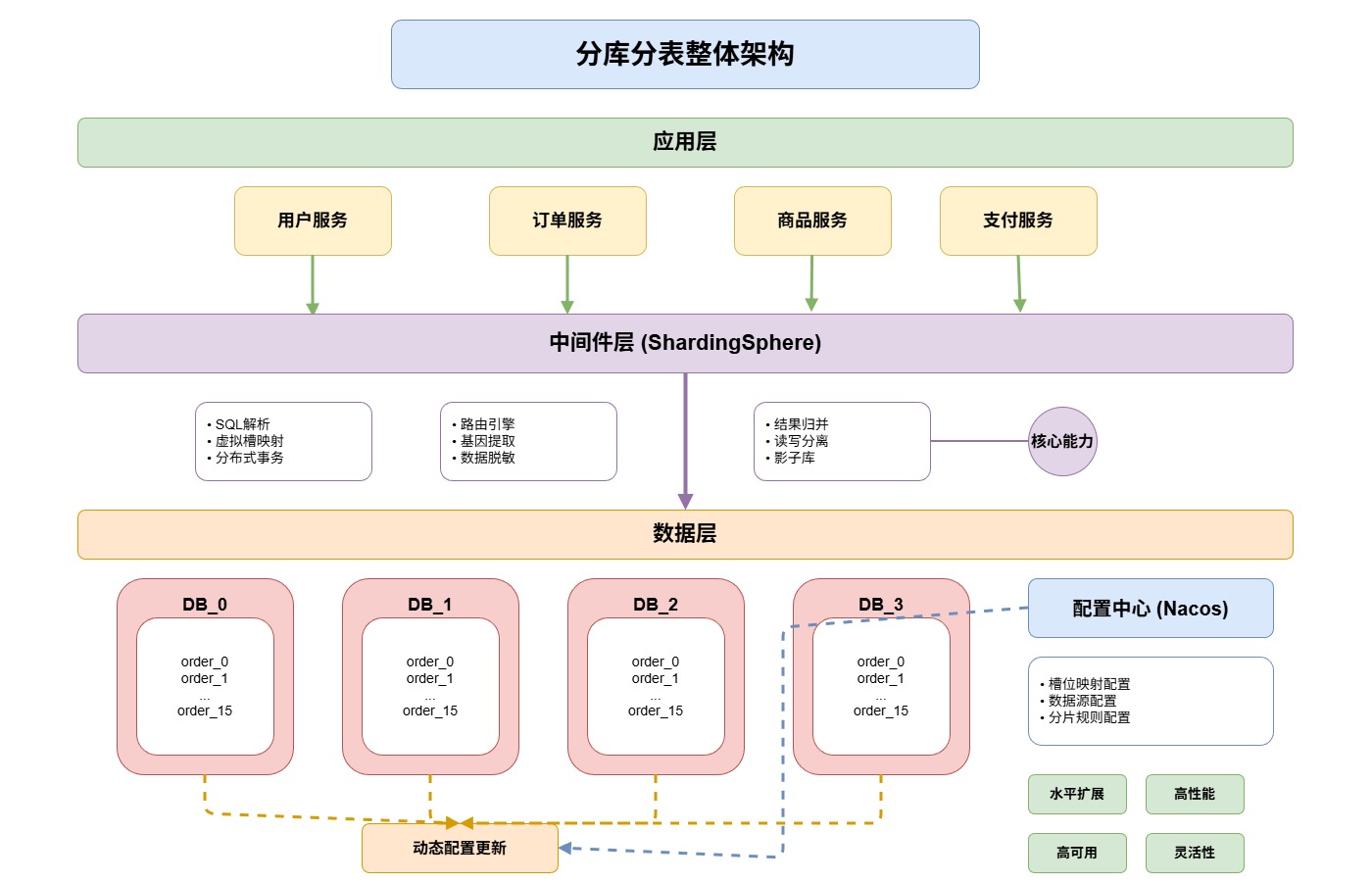
架构分层设计
关键组件设计
ID生成服务
/**
 * 分布式ID生成服务
 * 统一管理各业务线的ID生成策略
 */
@Service
public class DistributedIdService {

    @Autowired
    private Snowflake snowflake;

    private static final int GENE_BITS = 4;
    private static final long GENE_MASK = 0xF;

    /**
     * 生成带基因的订单ID
     * 确保同一用户的订单路由到同一分片
     */
    public long generateOrderId(long userId) {
        long baseId = snowflake.nextId();
        long gene = userId & GENE_MASK;
        return (baseId & ~GENE_MASK) | gene;
    }

    /**
     * 从订单ID提取用户基因
     * 用于反向验证或调试
     */
    public long extractUserGene(long orderId) {
        return orderId & GENE_MASK;
    }

    /**
     * 生成不带基因的普通ID
     * 用于不需要关联查询的业务表
     */
    public long generatePlainId() {
        return snowflake.nextId();
    }

    /**
     * 生成带商家基因的商品ID
     */
    public long generateProductId(long sellerId) {
        long baseId = snowflake.nextId();
        long gene = sellerId & GENE_MASK;
        return (baseId & ~GENE_MASK) | gene;
    }

    /**
     * 批量生成ID(提升性能)
     */
    public List<Long> batchGenerateOrderId(long userId, int count) {
        long gene = userId & GENE_MASK;
        List<Long> ids = new ArrayList<>(count);

        for (int i = 0; i < count; i++) {
            long baseId = snowflake.nextId();
            ids.add((baseId & ~GENE_MASK) | gene);
        }

        return ids;
    }
}
数据迁移服务
/**
 * 数据迁移服务
 * 支持虚拟槽扩容、数据重平衡等操作
 */
@Service
@Slf4j
public class DataMigrationService {

    @Autowired
    private JdbcTemplate sourceJdbcTemplate;

    @Autowired
    private JdbcTemplate targetJdbcTemplate;

    @Autowired
    private RedisTemplate<String, String> redisTemplate;

    /**
     * 虚拟槽扩容迁移
     * 将指定槽位范围的数据从源库迁移到目标库
     */
    @Transactional
    public MigrationResult migrateVirtualSlots(MigrationConfig config) {
        log.info("Starting migration: slots {} from {} to {}",
                 config.getSlotRange(), config.getSourceDb(), config.getTargetDb());

        MigrationResult result = new MigrationResult();

        try {
            // 1. 开启双写模式
            enableDoubleWrite(config);
            result.setPhase("DOUBLE_WRITE_ENABLED");

            // 2. 迁移历史数据
            long migratedCount = migrateHistoryData(config);
            result.setMigratedCount(migratedCount);
            result.setPhase("HISTORY_MIGRATED");

            // 3. 增量数据同步
            syncIncrementalData(config);
            result.setPhase("INCREMENTAL_SYNCED");

            // 4. 数据一致性校验
            ValidationResult validation = validateDataConsistency(config);
            if (!validation.isSuccess()) {
                throw new MigrationException("Data validation failed: " + validation.getMessage());
            }
            result.setPhase("VALIDATED");

            // 5. 切换读流量到新库
            switchReadTraffic(config);
            result.setPhase("READ_SWITCHED");

            // 6. 关闭双写,完成迁移
            disableDoubleWrite(config);
            result.setPhase("COMPLETED");
            result.setSuccess(true);

        } catch (Exception e) {
            log.error("Migration failed", e);
            result.setSuccess(false);
            result.setErrorMessage(e.getMessage());

            // 回滚操作
            rollback(config);
        }

        return result;
    }

    /**
     * 开启双写模式
     * 对待迁移槽位的数据同时写入新旧库
     */
    private void enableDoubleWrite(MigrationConfig config) {
        // 更新配置中心,开启双写
        String configKey = "sharding.double-write." + config.getSlotRange();
        redisTemplate.opsForValue().set(configKey, "true");

        log.info("Double write enabled for slots: {}", config.getSlotRange());
    }

    /**
     * 迁移历史数据
     */
    private long migrateHistoryData(MigrationConfig config) {
        long totalMigrated = 0;
        long lastId = 0;
        int batchSize = config.getBatchSize();

        while (true) {
            // 分批查询源库数据
            String sql = String.format(
                "SELECT * FROM %s WHERE id > ? AND (id %% 1024) BETWEEN ? AND ? ORDER BY id LIMIT ?",
                config.getTableName()
            );

            List<Map<String, Object>> batch = sourceJdbcTemplate.queryForList(
                sql, lastId, config.getStartSlot(), config.getEndSlot(), batchSize
            );

            if (batch.isEmpty()) {
                break;
            }

            // 批量插入目标库
            batchInsert(config.getTargetDb(), config.getTableName(), batch);

            totalMigrated += batch.size();
            lastId = (Long) batch.get(batch.size() - 1).get("id");

            log.info("Migrated {} records, total: {}", batch.size(), totalMigrated);
        }

        return totalMigrated;
    }

    /**
     * 增量数据同步
     * 使用Binlog或CDC方式同步迁移期间产生的新数据
     */
    private void syncIncrementalData(MigrationConfig config) {
        // 通过Canal或Debezium监听Binlog,同步增量数据
        // 这里简化处理,实际应使用专门的CDC工具
        log.info("Syncing incremental data...");
    }

    /**
     * 数据一致性校验
     */
    private ValidationResult validateDataConsistency(MigrationConfig config) {
        ValidationResult result = new ValidationResult();

        // 1. 校验记录数
        String countSql = String.format(
            "SELECT COUNT(*) FROM %s WHERE (id %% 1024) BETWEEN ? AND ?",
            config.getTableName()
        );

        Long sourceCount = sourceJdbcTemplate.queryForObject(
            countSql, Long.class, config.getStartSlot(), config.getEndSlot()
        );
        Long targetCount = targetJdbcTemplate.queryForObject(
            countSql, Long.class, config.getStartSlot(), config.getEndSlot()
        );

        if (!sourceCount.equals(targetCount)) {
            result.setSuccess(false);
            result.setMessage(String.format("Count mismatch: source=%d, target=%d",
                                           sourceCount, targetCount));
            return result;
        }

        // 2. 抽样校验数据内容
        // ... 随机抽取部分记录进行内容对比

        result.setSuccess(true);
        return result;
    }

    /**
     * 切换读流量
     */
    private void switchReadTraffic(MigrationConfig config) {
        // 更新配置中心的槽位映射
        String mappingConfig = buildNewSlotMapping(config);
        nacosConfigService.publishConfig("sharding-slot-mapping", mappingConfig);

        log.info("Read traffic switched to new db");
    }

    /**
     * 关闭双写
     */
    private void disableDoubleWrite(MigrationConfig config) {
        String configKey = "sharding.double-write." + config.getSlotRange();
        redisTemplate.delete(configKey);

        log.info("Double write disabled");
    }

    /**
     * 回滚迁移
     */
    private void rollback(MigrationConfig config) {
        log.warn("Rolling back migration...");
        disableDoubleWrite(config);
        // 清理目标库已迁移的数据
        // 恢复原有配置
    }
}
配置管理
Nacos动态配置
# sharding-config.yaml - 存储在Nacos配置中心
sharding:
  # 虚拟槽配置
  virtual-slots: 1024

  # 槽位到物理库映射(可动态修改)
  slot-mapping:
    - range: "0-255"
      database: db_0
      tables: 16
    - range: "256-511"
      database: db_2
      tables: 16
    - range: "512-767"
      database: db_1
      tables: 16
    - range: "768-1023"
      database: db_3
      tables: 16

  # 基因配置
  gene-config:
    order:
      gene-column: user_id
      gene-bits: 4
      gene-position: last  # 基因在ID中的位置
    product:
      gene-column: seller_id
      gene-bits: 4
      gene-position: last

  # 读写分离配置
  read-write-splitting:
    enabled: true
    load-balance-algorithm: round-robin
    primary: master
    replicas:
      - slave_0
      - slave_1

  # 分片算法配置
  algorithms:
    order-sharding:
      type: VIRTUAL_SLOT_WITH_GENE
      props:
        virtual-slots: 1024
        gene-bits: 4
配置热更新监听
/**
 * 配置热更新监听器
 * 监听Nacos配置变化,动态更新分片规则
 */
@Component
@Slf4j
public class ShardingConfigListener {

    @Autowired
    private VirtualSlotAlgorithm virtualSlotAlgorithm;

    @Autowired
    private ShardingSphereDataSource dataSource;

    /**
     * 监听槽位映射配置变化
     */
    @NacosConfigListener(dataId = "sharding-slot-mapping", groupId = "SHARDING")
    public void onSlotMappingChange(String newConfig) {
        log.info("Slot mapping config changed: {}", newConfig);

        try {
            // 解析新配置
            SlotMappingConfig config = parseConfig(newConfig);

            // 验证配置有效性
            validateConfig(config);

            // 热更新槽位映射
            virtualSlotAlgorithm.updateSlotMapping(config.getSlotMapping());

            log.info("Slot mapping updated successfully");

        } catch (Exception e) {
            log.error("Failed to update slot mapping", e);
            // 发送告警
            alertService.sendAlert("Slot mapping update failed: " + e.getMessage());
        }
    }

    /**
     * 监听数据源配置变化
     */
    @NacosConfigListener(dataId = "sharding-datasource", groupId = "SHARDING")
    public void onDataSourceChange(String newConfig) {
        log.info("DataSource config changed");

        // 动态添加/移除数据源
        // ShardingSphere支持运行时数据源变更
    }

    private void validateConfig(SlotMappingConfig config) {
        // 验证槽位覆盖完整性(0-1023必须全部覆盖)
        Set<Integer> coveredSlots = new HashSet<>();
        for (SlotRange range : config.getSlotMapping()) {
            for (int i = range.getStart(); i <= range.getEnd(); i++) {
                if (coveredSlots.contains(i)) {
                    throw new ConfigValidationException("Duplicate slot: " + i);
                }
                coveredSlots.add(i);
            }
        }

        if (coveredSlots.size() != 1024) {
            throw new ConfigValidationException("Slot coverage incomplete");
        }
    }
}
监控与治理
分片健康度监控
/**
 * 分片健康度监控服务
 */
@Component
@Slf4j
public class ShardingHealthMonitor {

    @Autowired
    private List<DataSource> dataSources;

    @Autowired
    private MeterRegistry meterRegistry;

    /**
     * 定时检查分片健康状态
     */
    @Scheduled(fixedDelay = 60000)
    public void monitorShardingHealth() {
        // 1. 检查数据分布均匀性
        checkDataDistribution();

        // 2. 检查热点分片
        checkHotSpots();

        // 3. 检查基因法有效性
        checkGeneEffectiveness();

        // 4. 检查各分片连接健康
        checkConnectionHealth();

        // 5. 检查慢查询
        checkSlowQueries();
    }

    /**
     * 检查数据分布均匀性
     */
    private void checkDataDistribution() {
        Map<String, Long> dataCountByDb = new HashMap<>();

        for (DataSource ds : dataSources) {
            String dbName = getDbName(ds);
            long count = queryDataCount(ds);
            dataCountByDb.put(dbName, count);

            // 上报Prometheus指标
            meterRegistry.gauge("sharding.data.count",
                               Tags.of("db", dbName), count);
        }

        // 计算数据分布方差
        double variance = calculateVariance(dataCountByDb.values());
        double mean = dataCountByDb.values().stream()
                                   .mapToLong(Long::longValue).average().orElse(0);
        double cv = Math.sqrt(variance) / mean;  // 变异系数

        meterRegistry.gauge("sharding.distribution.cv", cv);

        if (cv > 0.2) {  // 变异系数超过20%
            log.warn("Data distribution uneven, CV: {}", cv);
            alertService.sendAlert("数据分布不均匀,变异系数: " + cv);
        }
    }

    /**
     * 检查热点分片
     */
    private void checkHotSpots() {
        Map<String, Double> qpsByDb = new HashMap<>();

        for (DataSource ds : dataSources) {
            String dbName = getDbName(ds);
            double qps = queryCurrentQps(ds);
            qpsByDb.put(dbName, qps);

            meterRegistry.gauge("sharding.qps",
                               Tags.of("db", dbName), qps);
        }

        // 找出QPS最高的分片
        double maxQps = Collections.max(qpsByDb.values());
        double avgQps = qpsByDb.values().stream()
                               .mapToDouble(Double::doubleValue).average().orElse(0);

        if (maxQps > avgQps * 2) {  // 最大QPS超过平均值2倍
            String hotDb = qpsByDb.entrySet().stream()
                                  .max(Map.Entry.comparingByValue())
                                  .map(Map.Entry::getKey).orElse("unknown");

            log.warn("Hot shard detected: {}, QPS: {}", hotDb, maxQps);
            alertService.sendAlert("热点分片: " + hotDb + ", QPS: " + maxQps);
        }
    }

    /**
     * 检查基因法有效性
     */
    private void checkGeneEffectiveness() {
        // 随机抽取用户,检查其订单是否都在同一分片
        List<Long> sampleUserIds = getSampleUserIds(100);
        int failedCount = 0;

        for (Long userId : sampleUserIds) {
            Set<String> shards = findUserOrderShards(userId);
            if (shards.size() > 1) {
                failedCount++;
                log.warn("Gene method failed for user {}: orders in shards {}",
                        userId, shards);
            }
        }

        double failRate = (double) failedCount / sampleUserIds.size();
        meterRegistry.gauge("sharding.gene.fail.rate", failRate);

        if (failRate > 0.01) {  // 失败率超过1%
            alertService.sendAlert("基因法异常,失败率: " + failRate);
        }
    }

    /**
     * 检查连接健康状态
     */
    private void checkConnectionHealth() {
        for (DataSource ds : dataSources) {
            String dbName = getDbName(ds);
            try {
                Connection conn = ds.getConnection();
                boolean valid = conn.isValid(5);
                conn.close();

                meterRegistry.gauge("sharding.connection.health",
                                   Tags.of("db", dbName), valid ? 1 : 0);

                if (!valid) {
                    alertService.sendAlert("数据库连接异常: " + dbName);
                }
            } catch (SQLException e) {
                log.error("Connection check failed for {}", dbName, e);
                meterRegistry.gauge("sharding.connection.health",
                                   Tags.of("db", dbName), 0);
            }
        }
    }
}
实战注意事项
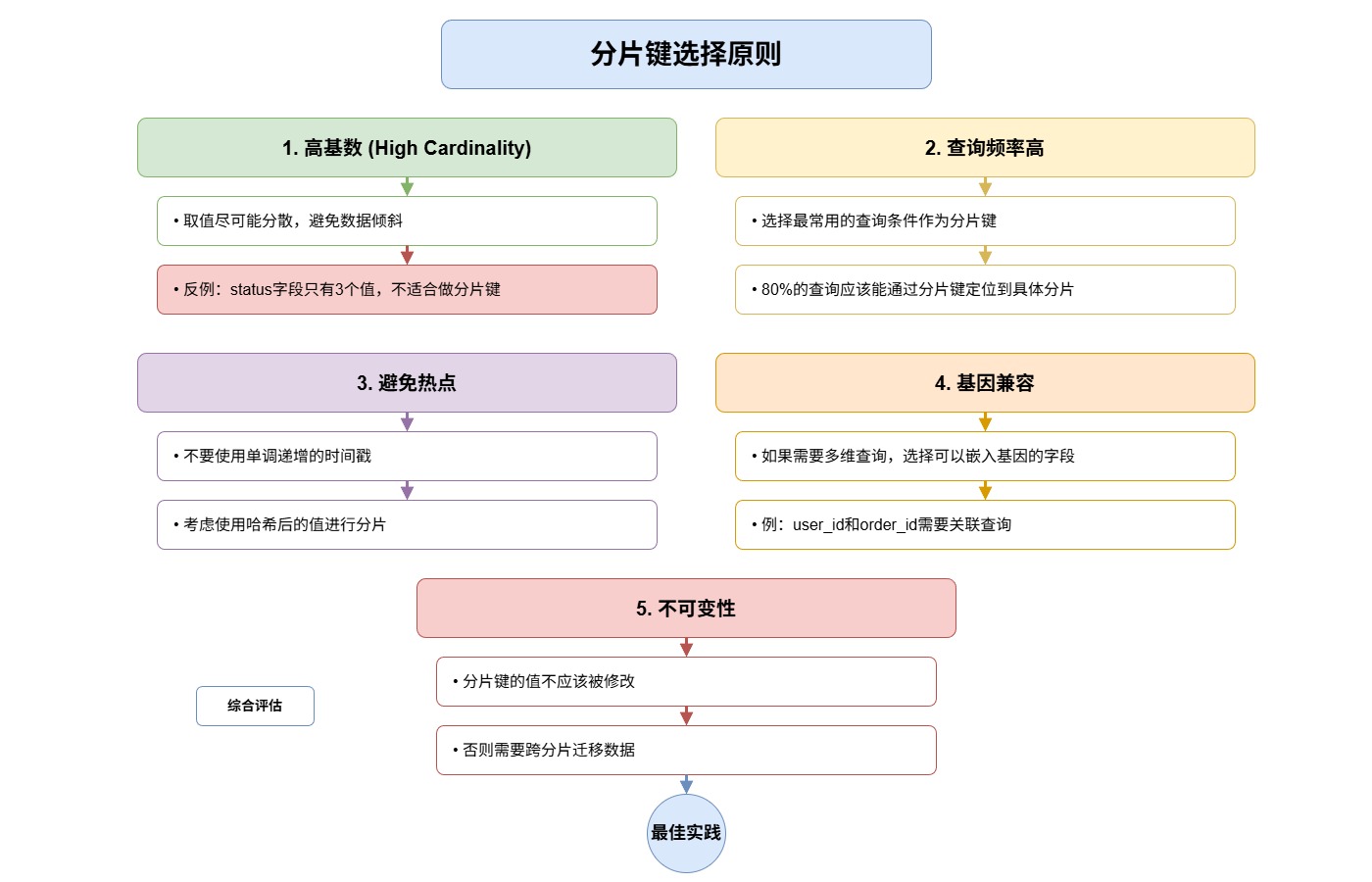
分片键选择原则
常见业务场景分片键推荐
| 业务表 | 推荐分片键 | 理由 |
|---|---|---|
| 用户表 | user_id | 用户查询频繁,天然均匀分布 |
| 订单表 | order_id (含user基因) | 支持按订单ID和用户ID两种查询 |
| 订单明细表 | order_id | 与订单表绑定,保证同一订单数据在同一分片 |
| 商品表 | product_id (含seller基因) | 支持按商品ID和商家ID查询 |
| 交易流水 | trade_id (含user基因) | 支持按流水ID和用户ID查询 |
| 日志表 | log_id + 时间分区 | 按时间范围归档,按ID查询 |
避免的坑
坑1:业务代码硬编码分片逻辑
// ❌ 错误示例:在业务代码中硬编码分片逻辑
public Order getOrder(Long orderId) {
    int shard = (int) (orderId % 4);  // 硬编码分片数!
    String tableName = "order_" + shard;
    String sql = "SELECT * FROM " + tableName + " WHERE id = ?";
    // 如果分片数变化,所有代码都要改!
    return jdbcTemplate.queryForObject(sql, Order.class, orderId);
}

// ✅ 正确做法:交给中间件处理
public Order getOrder(Long orderId) {
    // 直接查询逻辑表,中间件负责路由
    return orderMapper.selectById(orderId);
}
坑2:跨分片JOIN
-- ❌ 错误:跨分片JOIN,性能极差
SELECT o.*, u.name
FROM orders o
JOIN users u ON o.user_id = u.id
WHERE o.order_id = 123;
-- 如果orders和users在不同分片策略,需要跨库JOIN

-- ✅ 正确:使用基因法保证同分片,或拆分为多次查询
-- 方案1:基因法保证同分片
SELECT o.*, u.name
FROM orders o
JOIN users u ON o.user_id = u.id
WHERE o.user_id = 456 AND o.order_id = 123;
-- 通过user_id基因保证都在同一分片

-- 方案2:应用层聚合
SELECT * FROM orders WHERE order_id = 123;  -- 查订单
SELECT * FROM users WHERE id = 456;          -- 查用户
-- 应用层合并结果
坑3:全分片扫描
-- ❌ 错误:没有分片键条件,需要扫描所有分片
SELECT * FROM orders WHERE status = 'PAID';
-- 查询所有已支付订单,需要查询所有分片!

-- ✅ 正确:带上分片键或基因列
SELECT * FROM orders
WHERE user_id = 123 AND status = 'PAID';
-- 通过user_id定位分片

-- 对于必须全表查询的场景,考虑:
-- 1. 添加汇总表/宽表
-- 2. 使用ES等搜索引擎
-- 3. 使用数据仓库
坑4:分布式事务
// ❌ 错误:跨分片事务不会自动回滚
@Transactional
public void createOrderWithPayment(Order order, Payment payment) {
    orderMapper.insert(order);     // 分片A
    paymentMapper.insert(payment); // 分片B
    // 如果paymentMapper失败,orderMapper不会回滚!
}

// ✅ 正确:使用分布式事务框架
@GlobalTransactional  // Seata全局事务
public void createOrderWithPayment(Order order, Payment payment) {
    orderMapper.insert(order);
    paymentMapper.insert(payment);
    // Seata保证全局回滚
}

// 或者使用最终一致性方案
public void createOrderWithPayment(Order order, Payment payment) {
    // 1. 本地事务创建订单
    orderMapper.insert(order);

    // 2. 发送MQ消息,异步创建支付记录
    mqTemplate.send("payment-topic", payment);
    // 消费者处理失败会重试,保证最终一致
}
查询优化建议
-- 1. 使用绑定表查询(避免笛卡尔积)
-- 订单表和订单明细表使用相同分片键,配置为绑定表
SELECT o.order_id, oi.product_name
FROM orders o
JOIN order_items oi ON o.order_id = oi.order_id
WHERE o.order_id = 123;
-- ShardingSphere知道它们在同一分片,不会产生笛卡尔积

-- 2. 利用分片键范围查询
SELECT * FROM orders
WHERE user_id = 123
  AND create_time BETWEEN '2024-01-01' AND '2024-01-31';
-- user_id定位分片,create_time走分片内索引

-- 3. 批量查询优化
-- 按分片键分组后批量查询,减少跨分片请求
SELECT * FROM orders WHERE order_id IN (1,5,9);  -- 同一分片
SELECT * FROM orders WHERE order_id IN (2,6,10); -- 同一分片
-- 而非 IN (1,2,5,6,9,10) 导致多次跨分片

-- 4. COUNT优化
-- ❌ 避免
SELECT COUNT(*) FROM orders; -- 需要查询所有分片再聚合

-- ✅ 推荐
-- 维护计数表或使用缓存
中间件选择
| 中间件 | 特点 | 适用场景 |
|---|---|---|
| ShardingSphere | 功能全面,支持虚拟槽、基因法 | 大型分布式系统 |
| MyCat | 轻量级,易上手 | 中小型项目 |
| Vitess | Google开源,云原生 | 云环境、K8s |
| TiDB | NewSQL,自动分片 | 需要强一致性 |
总结:
技术价值
| 技术点 | 价值 | 复杂度降低 |
|---|---|---|
| 虚拟槽技术 | 扩容复杂度从O(n)降到O(1) | 只需迁移少量数据 |
| 基因法设计 | 多维查询无需全库扫描 | 用数学优雅解决业务问题 |
| 配置驱动 | 业务代码零修改 | 通过配置中心动态调整 |
| 完整工具链 | 包含迁移、监控、校验 | 运维自动化 |
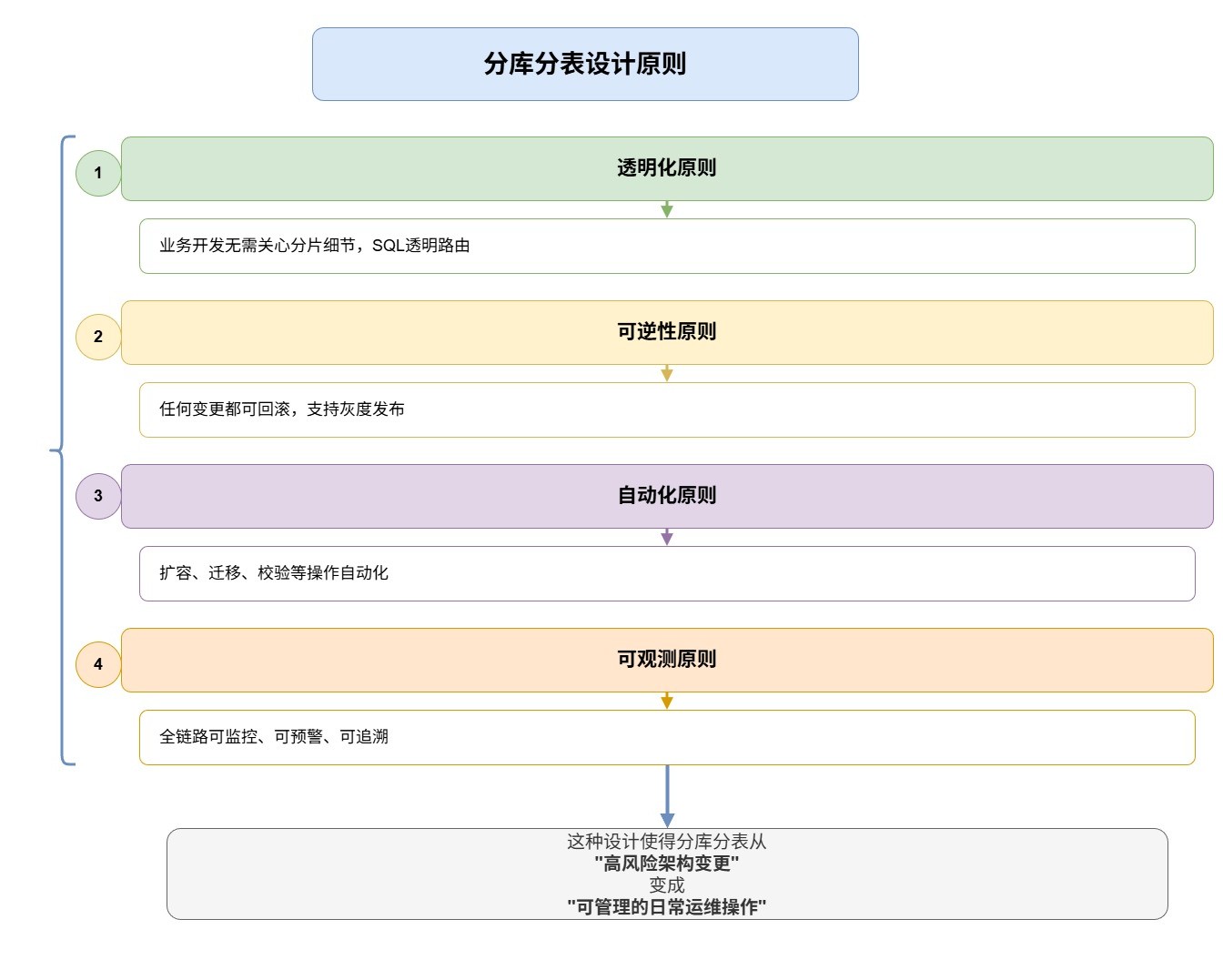
设计原则
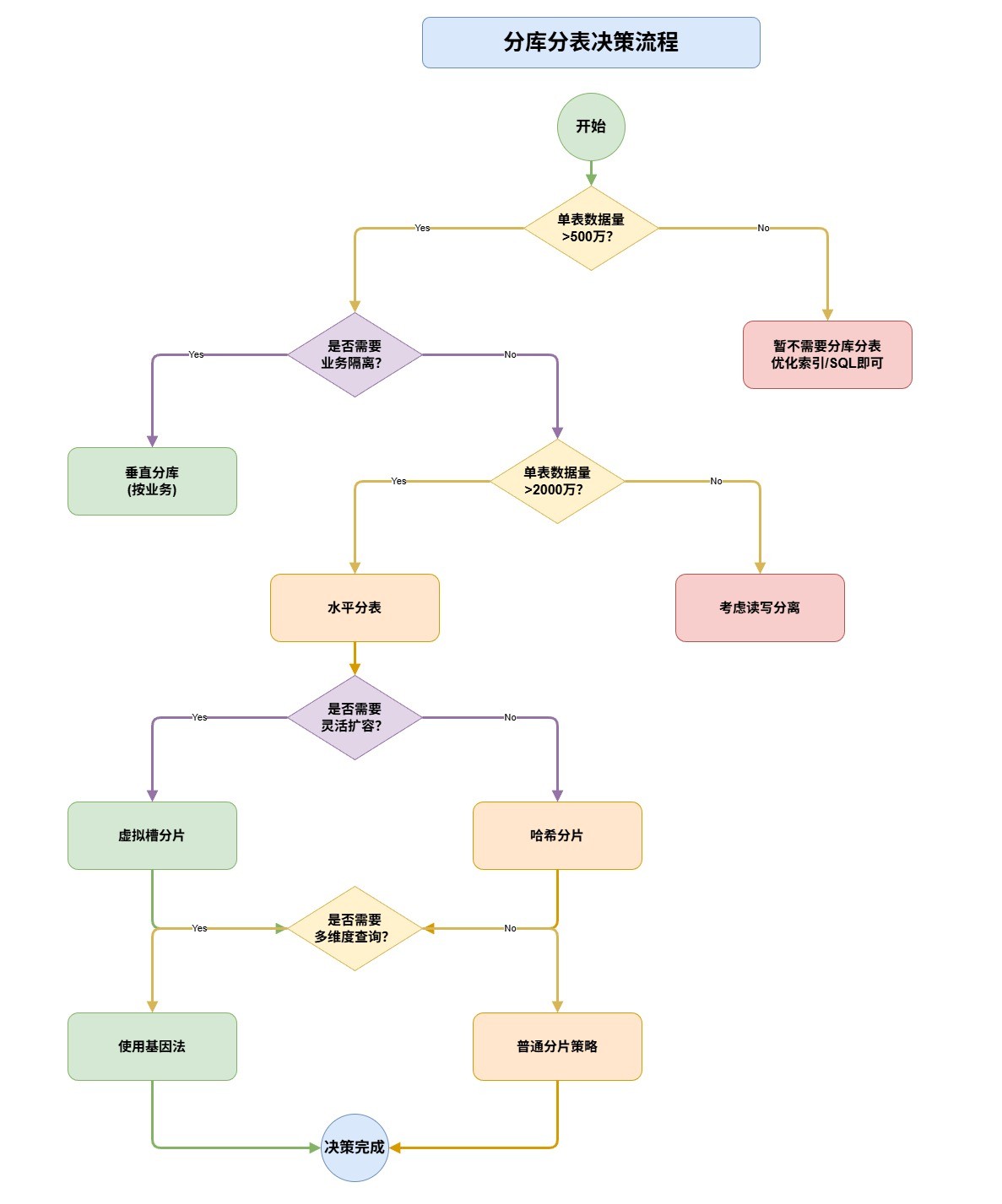
决策流程图
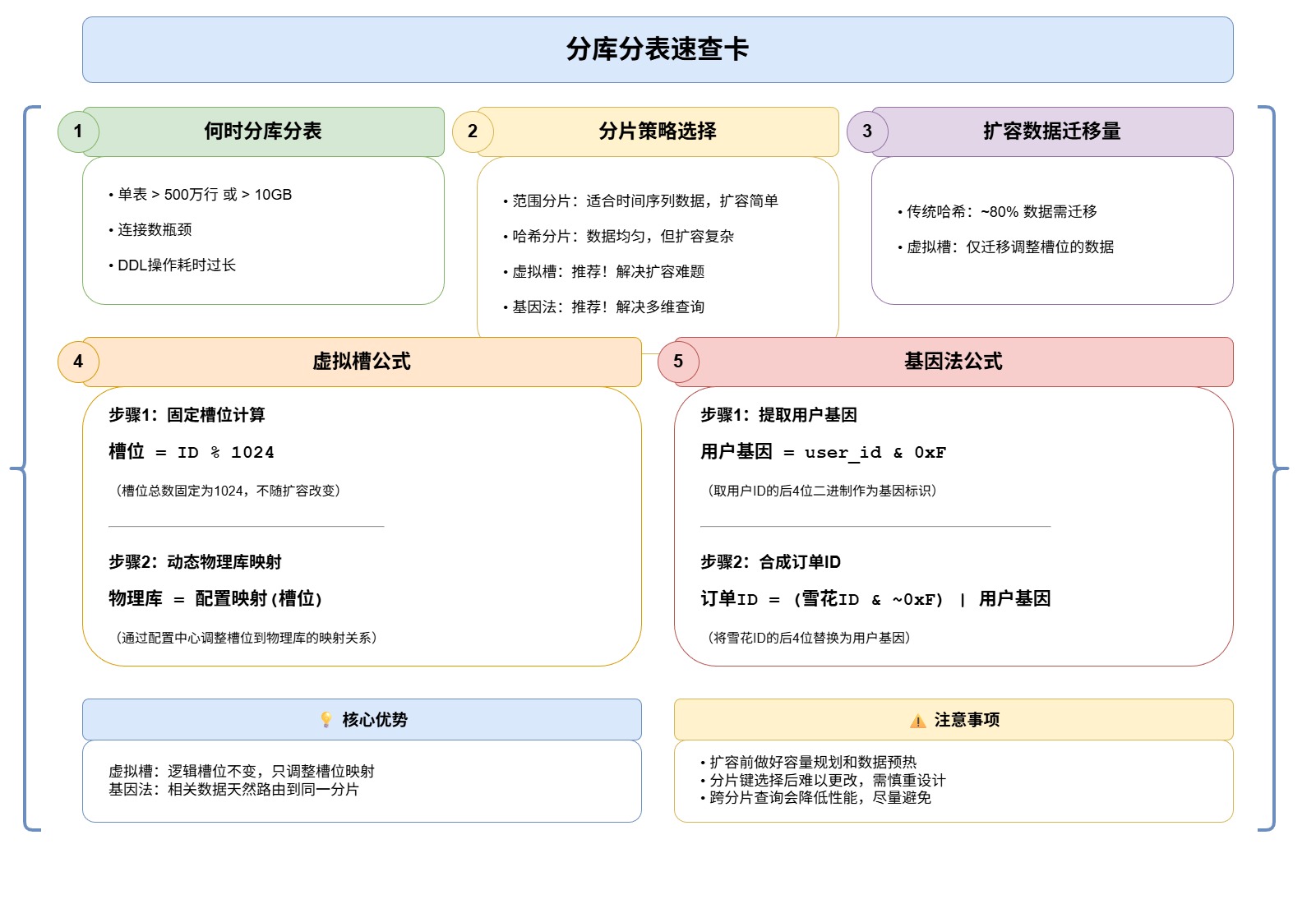
Quick Reference Card
企业级项目导航:⬅️ 01-为什么掌握分片原理就能很容易实现分库分表? | 02-分库分表最佳实践:从基础原理到高阶架构设计 | ➡️ 01-用户服务分库分表设计思维全景
💬 评论